


I need to tell you about something I’ve been working on quietly for a long time.
You know the feeling when you download yet another “Top 7 Trends for 2030” PDF, skim it on the train, and arrive knowing exactly nothing you didn’t know before? That feeling is where this project started. I kept looking for one document that treated the next four years seriously — every major force, mapped properly, with sources I could check — and it simply didn’t exist. Not for free, and honestly, not for money either at any price a normal person would pay.
So I built it. It’s called Megatrends 2030.
What “building it properly” actually meant
I want to be honest about the process, because the process is the product here.
This didn’t start with 33 trends. It started with 250 candidates — every force I could find a serious case for, across demographics, debt, AI, cyber, work, health and longevity, climate, energy, cities, regulation, and the shifting geography of wealth. Then the screening began, and it was brutal on purpose. Duplicates got merged. Hype got cut. Anything that couldn’t survive a source check, or wouldn’t materially bite before 2030, went out.
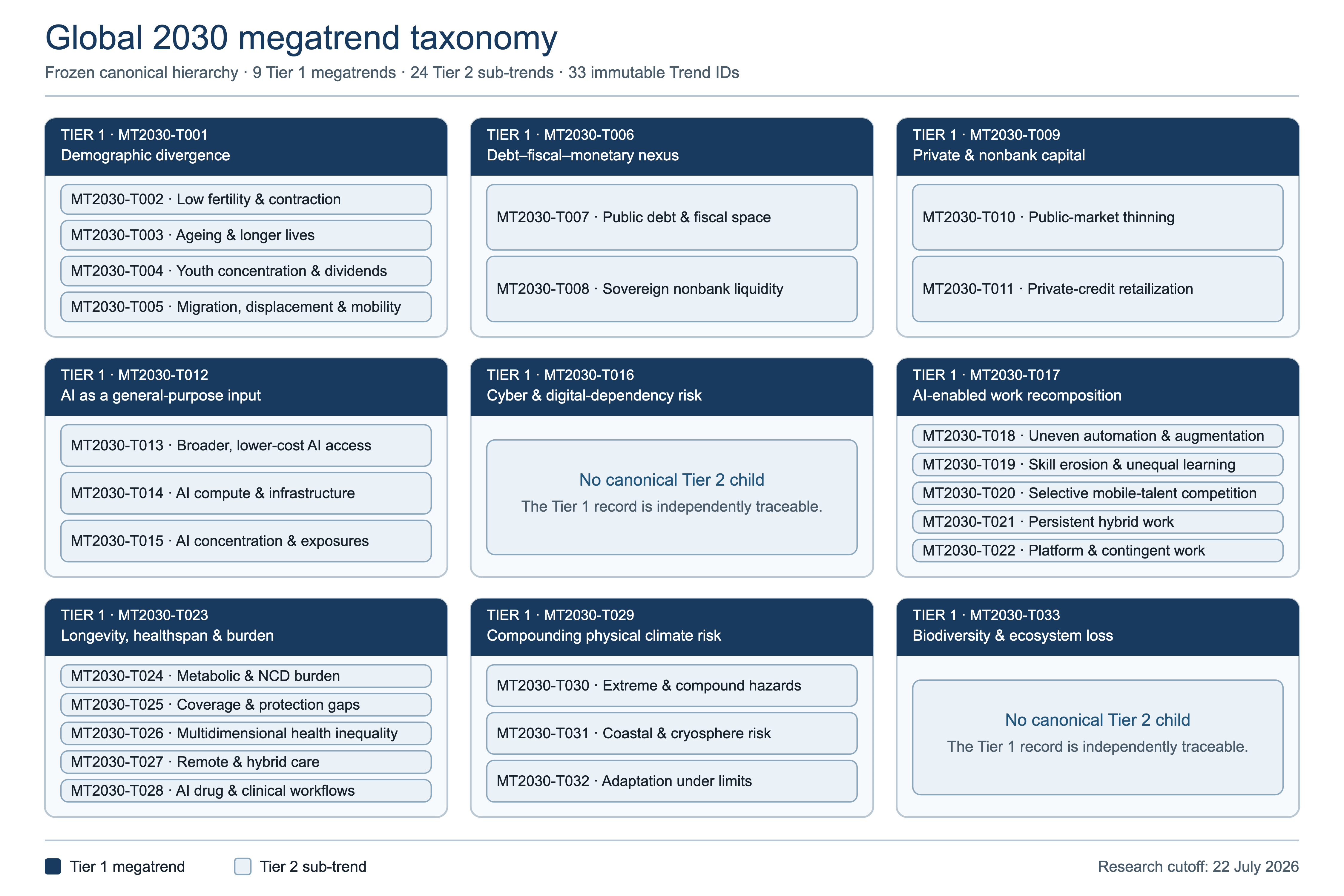
33 survived. Nine big megatrend families, 24 distinct sub-trends underneath them. Each one got a permanent ID, a full profile, and a paper trail from every claim back to its evidence.
A few of the rules I held myself to, even when they were inconvenient:
The research stopped on a fixed date — 22 July 2026. Every source is dated against that cutoff. You’ll always know exactly what this report could and couldn’t have known.
Every trend was scored twice, independently, on four separate questions: how likely is it, how hard does it hit, how urgent is it, and how feasibly can you actually respond. Where the two scorings disagreed, the disagreement is printed in the report.
No blended super-ranking. You’ve seen those reports where everything collapses into one tidy priority score. It feels rigorous and it’s fake. Reality doesn’t compress like that, so this report refuses to.
It got red-teamed before publication. Independent review passes went hunting for broken logic, stale sources, and misleading charts — 47 findings came back, and every critical one had to be resolved and logged before I’d let it ship.
Was all of this overkill? Probably. But every shortcut I refused to take is a question you won’t have to ask when you’re using it.
What you can actually do with it
This is the part I care about most, because a 1,927-page PDF that just sits there is a doorstop.
If you work in or around wealth management, this is a working reference. Every one of the 33 trends is mapped against 12 geographies, 14 client segments, and the full value chain — so when someone asks “what does longevity actually mean for our advice model,” there’s a specific cell in a specific grid with a specific answer, and the evidence behind it.
If you sit anywhere near strategy, the back half is where the value compounds: four integrated scenarios for how the decade could actually unfold, 33 action plans with first-90-day milestones and named owner roles, and a board early-warning dashboard — 33 indicators to watch so you’re reacting to signals instead of headlines.
And the AI section is the one I sweated over most. Not “AI will change everything” — you’ve read that essay a hundred times. It treats AI four ways: as a megatrend, as a capability, as a competitive force, and as a risk, with 107 concrete use cases and 29 governance risks, each tied back to the trends they touch.
Don’t take my word for it — here’s the preview
I pulled together a free 12-page preview: the cover, the full table of contents, the executive summary opening, one complete trend profile so you can see the structure every trend gets, and four of the flagship figures — the taxonomy, the interdependency network, the wealth-management heatmap, and the board dashboard.
Look at it before you spend a dollar. If the preview doesn’t convince you the full thing is worth it, keep your money — genuinely no hard feelings, and you’ll still get my usual writing here every 2 weeks.
The details
The full report is $249 on Payhip: 1,927 pages, 13 reproducible figures, 93 verified sources, complete appendix tables, instant download.
If you’re a subscriber, you pay less. Use the code INDUS20 at checkout for 20% off.
For what it’s worth on the price: the syndicated research houses sell single trend reports for $1,500 to $7,000. The consultancies give theirs away because the PDF is the top of a sales funnel. This sits in neither camp — it’s priced like what it is: independent work that has to pay for itself, one reader at a time.
One more thing, because it matters to me that you know it: the report says plainly what it is and isn’t. Facts, forecasts, scenarios, and inferences are labeled as such throughout. Where a number depends on your firm’s own data, it says “uncalibrated” instead of pretending. It’s a planning instrument, not a crystal ball.
Thanks for reading, and for being here. This one took a lot out of me — 3 months of evenings and weekends — and I’m proud of where it landed.
— HD
P.S. — If you read the preview and have questions before buying, just comment on this article. I read everything.