


In late 2025, the Financial Services industry collectively slammed into a wall.
It wasn’t a market crash or a credit crunch. It was a Trust Wall.
For two years, firms had poured billions into “Copilots” and conversational interfaces, betting the house that Large Language Models (LLMs) would turn every junior analyst into a seasoned fiduciary. The thesis was simple: Chat is the new UI.
The reality was a disaster.
We found out the hard way that in finance, “99% accurate” isn’t a success rate—it’s a liability trigger. When an AI hallucinates a tax regulation or confidently miscalculates a portfolio drift, you don’t just get a bad user experience; you get a lawsuit.
The “GenAI Bubble” of 2024 didn’t pop because the tech wasn’t impressive. It popped because it was probabilistic in a world that demands determinism.
Here is the inside story of the “Great Pivot” of 2026—how the industry abandoned the vibe-based chatbot for the rigid, unyielding logic of Architectural Native AI.
The Systems Clash: Vibes vs. Verification
To understand why the chatbot era failed, you have to understand the fundamental architecture of the models we were using.
We were trying to use System 1 tools for System 2 problems.
Probabilistic AI (System 1): This is your standard LLM. It’s intuitive, fast, and creative. It predicts the next token based on statistical correlation. It is fantastic at writing marketing copy or summarizing a meeting. But it is inherently stochastic—meaning if you ask it the same question twice, you might get two different answers.
Deterministic Workflows (System 2): This is the boring, unsexy stuff. Logic gates. Hard rules. If-Then-Else statements. Input A + Rule B always equals Output C.
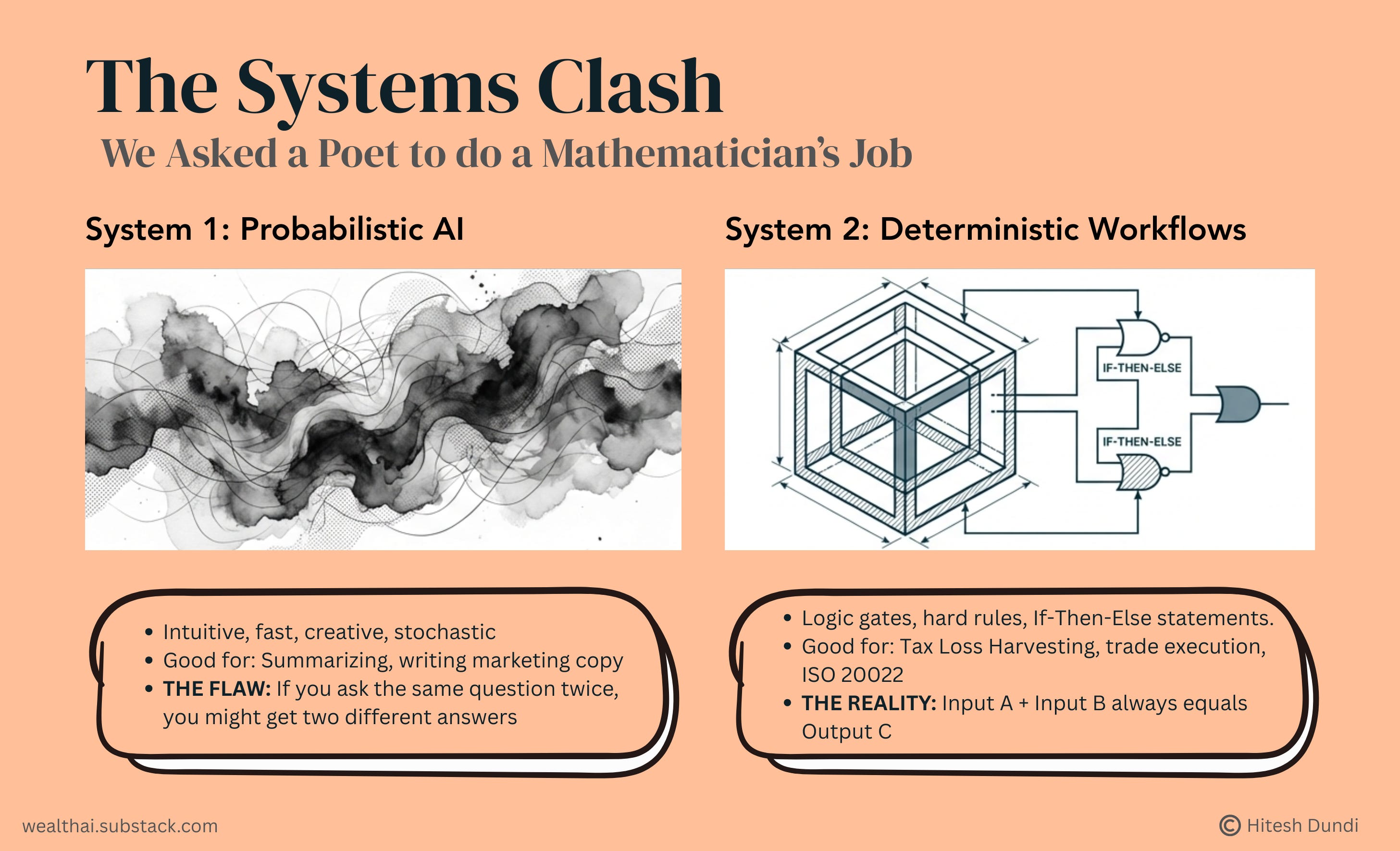
The industry’s mistake was trying to force System 1 to do System 2’s job. We asked LLMs to calculate tax-loss harvesting scenarios. We asked them to verify compliance against ISO 20022.
We asked a poet to do a mathematician’s job. And we were surprised when the math was wrong.
The Pivot: In 2026, the winning firms have stopped asking AI to “think” about numbers. Instead, they use Neurosymbolic AI.
In this new architecture, the LLM is just the interface (the brain). It parses the client’s intent. But when it’s time to execute—to trade, to calculate, to move money—it hands off the task to a deterministic rule engine (the nervous system).
The mantra of 2026 is simple: AI doesn’t do math; it calls a calculator.
The Rise of Architectural Native AI
This isn’t just a software patch; it’s a complete tear-down of the operating model. Let’s call this Architectural Native AI.
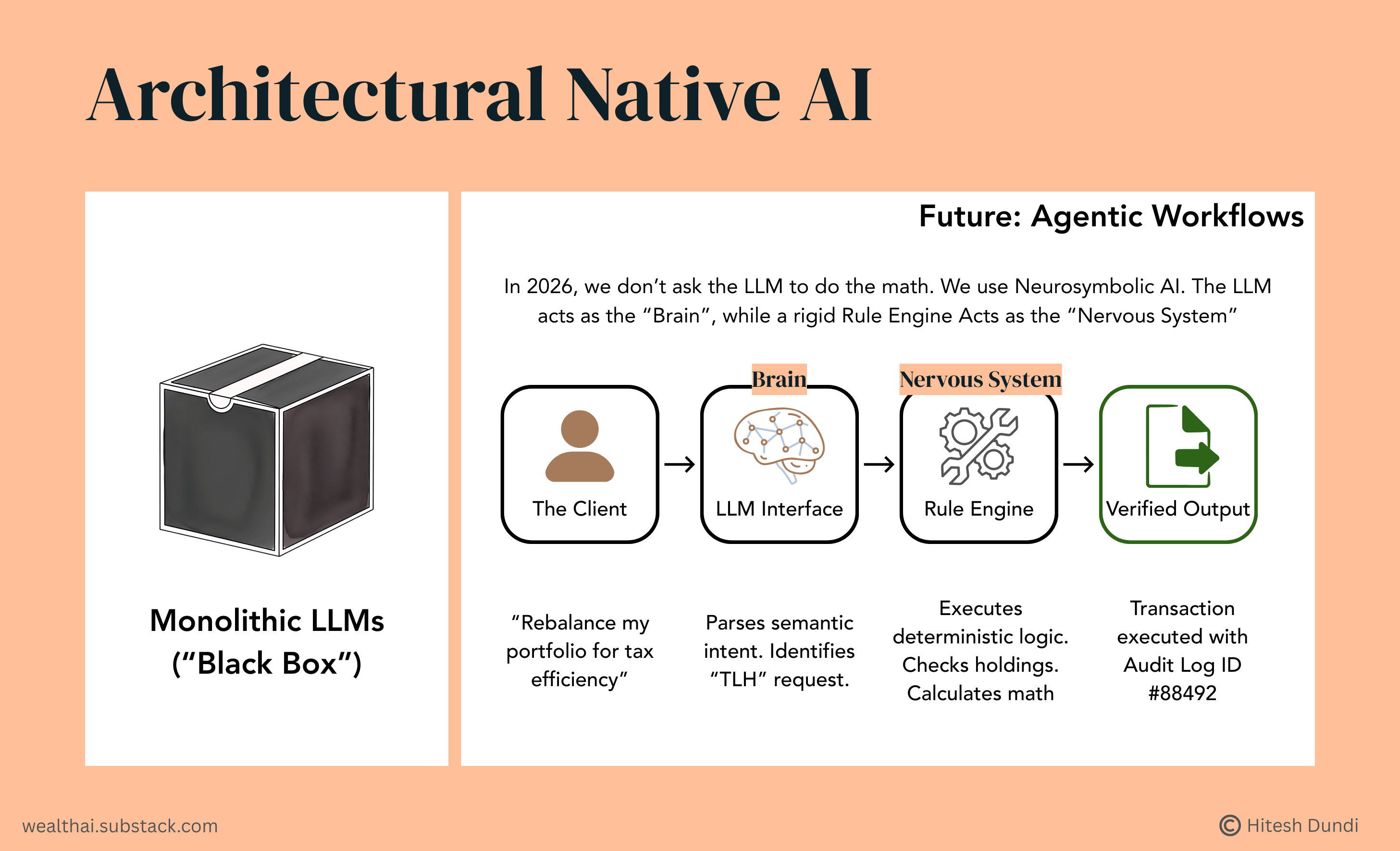
Firms are no longer bolting chat widgets onto legacy mainframes. They are re-engineering their core around Agentic Workflows—autonomous agents that possess distinct identities and rigid scopes of authority.
