

Somewhere in some corporate office a team is presenting to their leadership that they’re celebrating a 97% cost reduction on their AI token usage. They might have swapped a frontier model out of their document pipeline for a cheap, economic, and likely a Chinese AI model. The invoice line might have dropped from 13 cents per case to $0.003, so everyone’s happy.
When you follow the cost dashboard all the way to its finished results and accepted value, the cheaper route costs $133 per accepted case and the frontier route it replaced cost $71. And the third design that I want to highlight would cost somewhere around $29.75.
These numbers follow a modeled scenario in a research program I’ll spend the rest of the piece unpacking. The scenario is a regulated client onboarding workflow, priced with August 2026 rates, a $90 per hour loaded human cost.
Ultimately, the conclusion it points to is an uncomfortable truth every AI cost conversation would discover this quarter across AI transformation teams justifying AI spend. The conclusion is that you cannot see AI waste on an AI invoice. The waste trickles downstream in retries, review minutes, rework, and defects that humans are doing, and typically invoices do not have a column for any of it.
The wrong denominator
Typically, an AI cost discussion in corporate boardrooms is centered around dollars per million tokens or cost per API call. I think both are fine for reconciling invoices, but they are useless if you want to answer the question: is the workflow that the AI is generating and the value it is delivering a good deal at the end of the day?
A cheaper API call doesn’t make the entire AI workflow cheap. It might hit you back in ways such as retries, escalations, and numerous minutes that coders spend reconstructing the code or identifying a defect that the AI model is stubbornly adamant on not solving. But if you think about a pricier API call to a frontier intelligent reasoning model, the first try itself might render the result that people need, and it is what everyone needs at the end of the day. So I think that we need to move towards a new outcome variable that is our new KPI: cost per accepted outcome, where everything that the workflow consumed—be it model, tools, retries, human reviews, remediation, and all of this—is divided by the number of results we actually accepted and shipped by the end of the day.
cost per accepted outcome =
  (model + tools + retries + review + remediation) ÷ accepted results
Change the denominator and these rankings would definitely flip for the research case. In the onboarding scenario being considered here, the most economic model’s success rate was 62%, and each failure pushed about 55 minutes of reconstruction onto human reviewers. The expensive frontier call failed less but still dumped a 35-minute review burden onto human reviewers. The winning route is not actually a model choice at all—it is a workflow choice: selective evidence extraction, deterministic checks, and an exception queue.
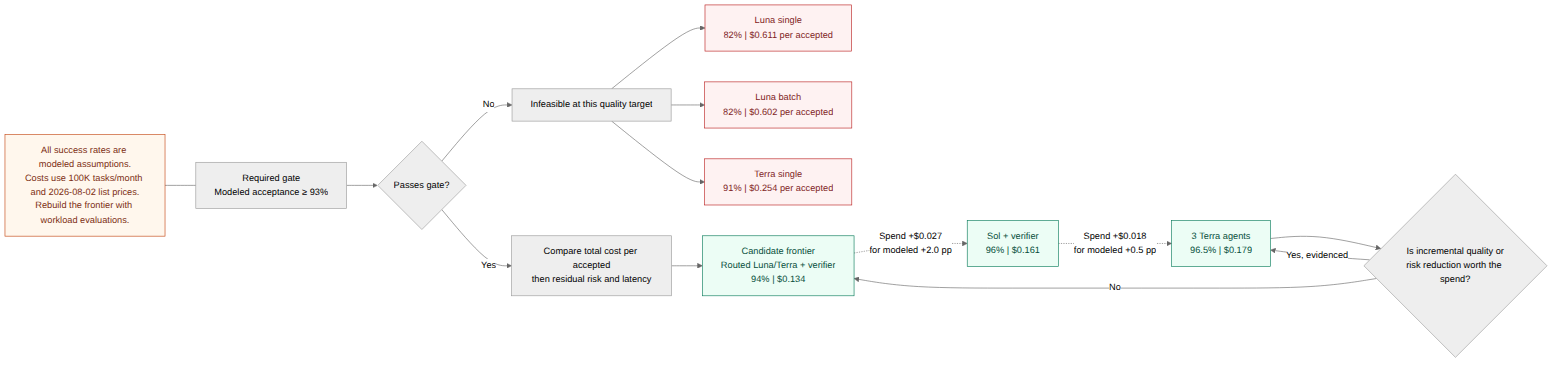
Also, this isn’t a one-off scenario. When the research modeled a long document extraction pipeline, the whole packet into the frontier model costed $28.31 per accepted record, and the cheap model’s extraction costed $40.35. So the cheap model is the worst of the four, and again, because reviewers inherit everything the model didn’t do, disciplined selection with provenance and targeted repair is really important.
This pattern repeats across ten use cases: cheap inference is very often a cost transfer, not a cost reduction. The money doesn’t disappear magically, it moves from the API invoice, where you’re looking, to human minutes, where you aren’t.
Model context window is not a target
The flip side of the cheap model mistake is that people usually think that if there is a context window available, just completely fill it with whole repositories, entire document packets, full CRM histories, every prior conversation turn, and this replays onto the context on every turn and eventually gets compacted within the conversation. Let’s put some numbers on this, for example, fixing a localized bug with a naive repo dump took 87,180 input tokens, while a disciplined version we reproduced the bug, retrieved the failing test and the exact symbols involved, patch, and rerun it needed 20,615 tokens. That is four times less input and a higher success rate because the model isn’t reading 87,000 tokens of mostly irrelevant code on every turn.
My favorite detail in the whole study is that in the cross-service refactor scenario, the naive dump crosses a 272,000-token threshold on the dated price card, which triggers a long-context surcharge on the entire request. So the bloated prompt doesn’t just waste tokens; it shoves the whole call into a more expensive pricing tier. And the marginal context can change your unit price discontinuously.
The waste hides in respectable places. The study’s top offenders:
Repeated static context — the same instructions and documents re-sent on every call, cache be damned! :)
Verbose tool output retained forever — the log was validated once; it’s still being re-read every turn
Retries without a new hypothesis — the same failing prompt, resubmitted with hope
Agent teams reading the same sources — five workers, one corpus, five times the bill, one integration headache
Frontier models doing deterministic work — arithmetic, permission checks, and format conversions that software does for free, flawlessly
Here’s the twist: the fix is not brevity. One scenario in the study moved cache hits from 0% to 90% dropping direct model cost materially, and the cost per accepted outcome barely moved, because review and remediation dominated the total. The shift in the human review assumption moved the number far more than caching ever could.
Token discipline optimizes the outcome.
If cheap-and-lean can be wrong, and big-and-expensive can be wrong as well, so, what’s actually right?
That’s the second half of this piece along with the complete report. It has the operating system: the ten principles, the eight-step routing policy that decides every task, the one formula that ends model-picker debates, the exact conditions under which you should spend more, and the 30/60/90 plan to install all of it.
Download the subscriber cheat sheet from below.