


Part 1 of 6 in What It Takes: AI Agents in Wealth
What baffles me about the current talk on AI agents is how simple it makes the job sound. The common line, in one form or another, is that the models are ready and what a firm needs now is a context layer and data in the right shape. Salesforce published a piece in January calling context “the foundation of agentic AI.” Glean wrote in September that agents need “an enterprise context layer that retrieves the most authoritative information from connected systems.” In a piece on wealthtech trends for 2026, the chief executive of Milemarker, a wealth data company, wrote that the biggest blocker to agentic AI “isn’t any of those things. It’s data.”
None of them claims context is the whole job, and Glean says plainly that search alone is not enough. Context matters; my own results show how much. But the emphasis has settled there, and it leaves out the larger part of the work. The model is the smallest part of an agent that can be trusted with a client’s money. What surrounds it is what engineers have started calling the harness: how you test the agent, what you let it do, how it reaches the firm’s knowledge, and what all of that costs to run. I built one end to end, for a money movement exception queue, to find out how large that job is.
It is large.
The word “agent” gets used for almost anything with a chat box, so it is worth pinning down. Simon Willison, a programmer who has written about this more carefully than most, settled in 2025 on a definition: “An LLM agent runs tools in a loop to achieve a goal.” He had earlier written up a talk by Hannah Moran of Anthropic that put it almost the same way: “agents are models using tools in a loop.”
Each part of the definition does work. The LLM, the large language model, reads and writes text and remembers nothing between calls. A tool is a function the firm’s own software offers it: look up this client’s payees, read section 6.3 of the procedures manual, calculate the total debit on this wire. The model cannot run a tool. It asks, and the software decides whether to run it and hands back the result. The loop lets the model ask again, read again, and decide when it has enough. The goal is what ends the loop.
Everything that is not the model is the harness. Vivek Trivedy of LangChain put it as a formula in March: “Agent = Model + Harness.” The harness decides what the model sees, which tools exist, what the model is allowed to do with them, what gets saved if the process crashes halfway through a request, what gets recorded for a supervisor, and how anyone knows whether the whole thing is any good. Mitchell Hashimoto, who has written about building software alongside these agents, calls the practice of improving it “harness engineering.” In my build, nearly all the engineering went there.
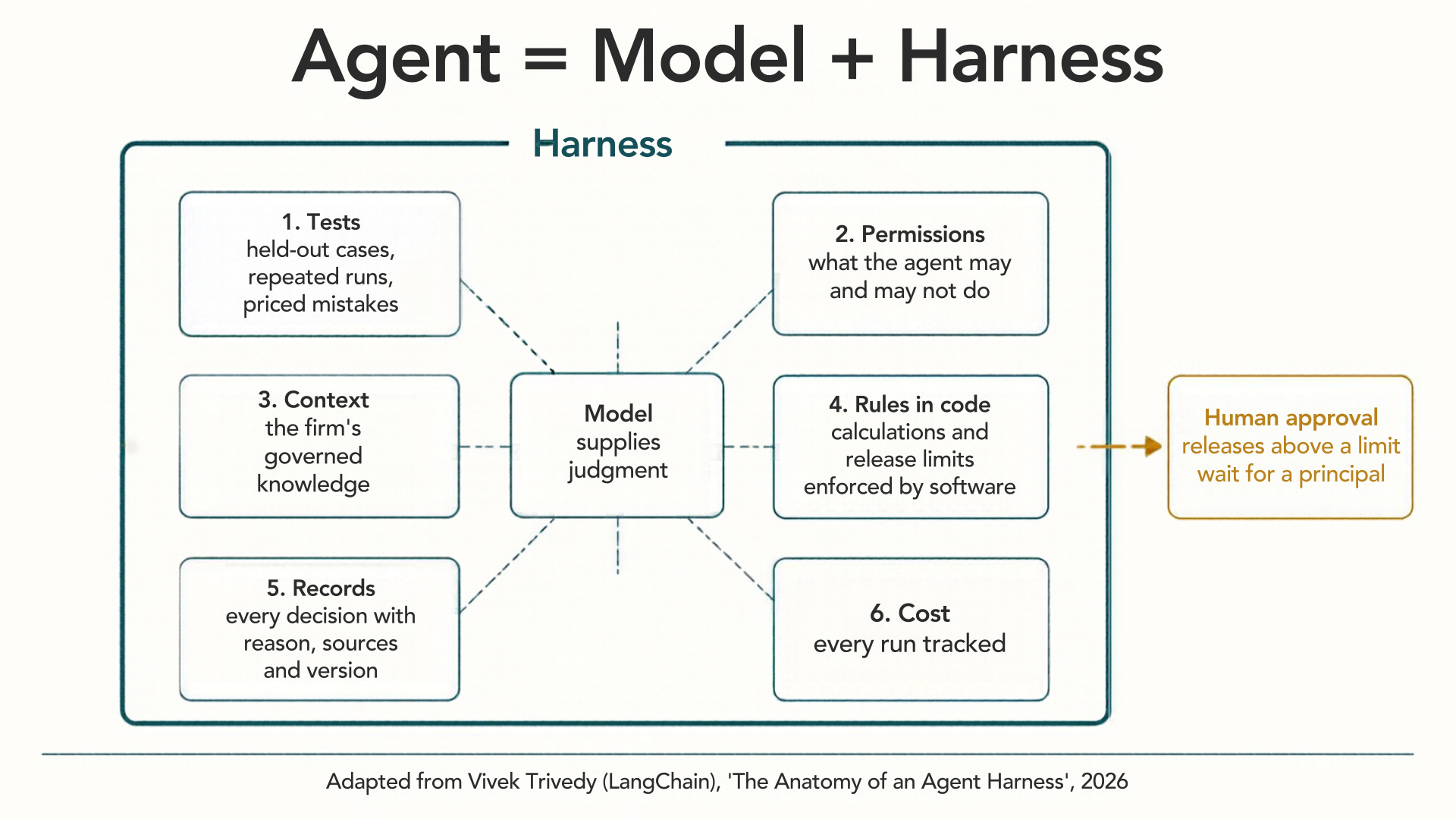
The model supplies judgment. Everything that makes that judgment safe to act on, someone has to build.