


574 vendors. 36 categories. 12 tools on every desk. AI made it easy to build wealth management software. It didn't make it easy to build software that matters.
She closed the tab at 9:07 on a Tuesday morning.
The demo had taken eleven minutes. A polished young founder in a Patagonia vest had walked her through something called an “AI-powered client engagement platform.” The interface was clean. The animations were smooth. It could transcribe meetings, draft follow-up emails, and generate a summary of portfolio changes — all in under sixty seconds. “We’re transforming how advisors connect with clients,” he’d said, using the word transforming the way a sommelier pours a mediocre Pinot Noir: with unearned confidence.
She’d smiled, nodded, said she’d think about it.
Then she opened her CRM. Typed a note, by hand, in the clumsy little text box she’d used for twelve years. The note was about Julie Stevens, a seventy-three-year-old retired schoolteacher whose mother had died the previous Thursday. Julie needed to rethink her estate plan, but more urgently, Julie needed someone to acknowledge that her mother — ninety-six years old, sharp until the very end — had been the last living person who remembered Julie as a child. No algorithm was going to do that. No AI-powered engagement platform was going to understand that this Tuesday, for this particular client, the correct financial planning action was to say almost nothing about finances at all.
She saved the note. Took a sip of coffee. Looked at the three other demo invitations sitting in her inbox, each promising to “revolutionize” something.
She deleted all three.
Here is the thing about the word slop.
In December 2025, Merriam-Webster’s editors sat in a room and selected it as the Word of the Year. Not “AI.” Not “agent.” Not “disruption” or “transformation” or any of the gleaming vocabulary that has become the liturgical language of Silicon Valley. They chose slop. A word from the 1700s meaning “soft mud.” A word that evolved in the 1800s to describe food waste — pig feed, kitchen scraps, the stuff left over after everything useful had been extracted. The dictionary’s formal 2025 definition: “digital content of low quality that is produced usually in quantity by means of artificial intelligence.”
The runners-up told the rest of the story. “Touch grass” — the internet’s way of telling someone to go outside and participate in reality. “Performative” — an adjective for things that look like the real thing but aren’t.
The cultural mood of 2025 wasn’t anti-technology. It was anti-thoughtlessness. A collective exhaustion with things that are adequate enough to ship but not good enough to matter.
This article isn’t about content slop — the AI-generated articles, the synthetic stock photos, the uncanny social media posts that have colonized every feed. That problem is well-documented. What hasn’t been named yet, at least not with the precision it deserves, is what happens when the same forces that produce content slop start producing products. Specifically, software products. More specifically, the software products being aimed at the financial advisory industry with the velocity of a t-shirt cannon at a minor league baseball game.
Welcome to the era of product slop. And no industry on earth is more saturated with it than wealth management technology.
The Map That Explains Everything
In April 2018, Michael Kitces — a man who has built an entire media empire on the proposition that taking fintech seriously is both possible and necessary — published the first edition of his Financial AdvisorTech Solutions Map. It was a modest document. A hundred and eighty-nine companies spread across twenty-nine categories. A useful field guide to a growing but navigable ecosystem.
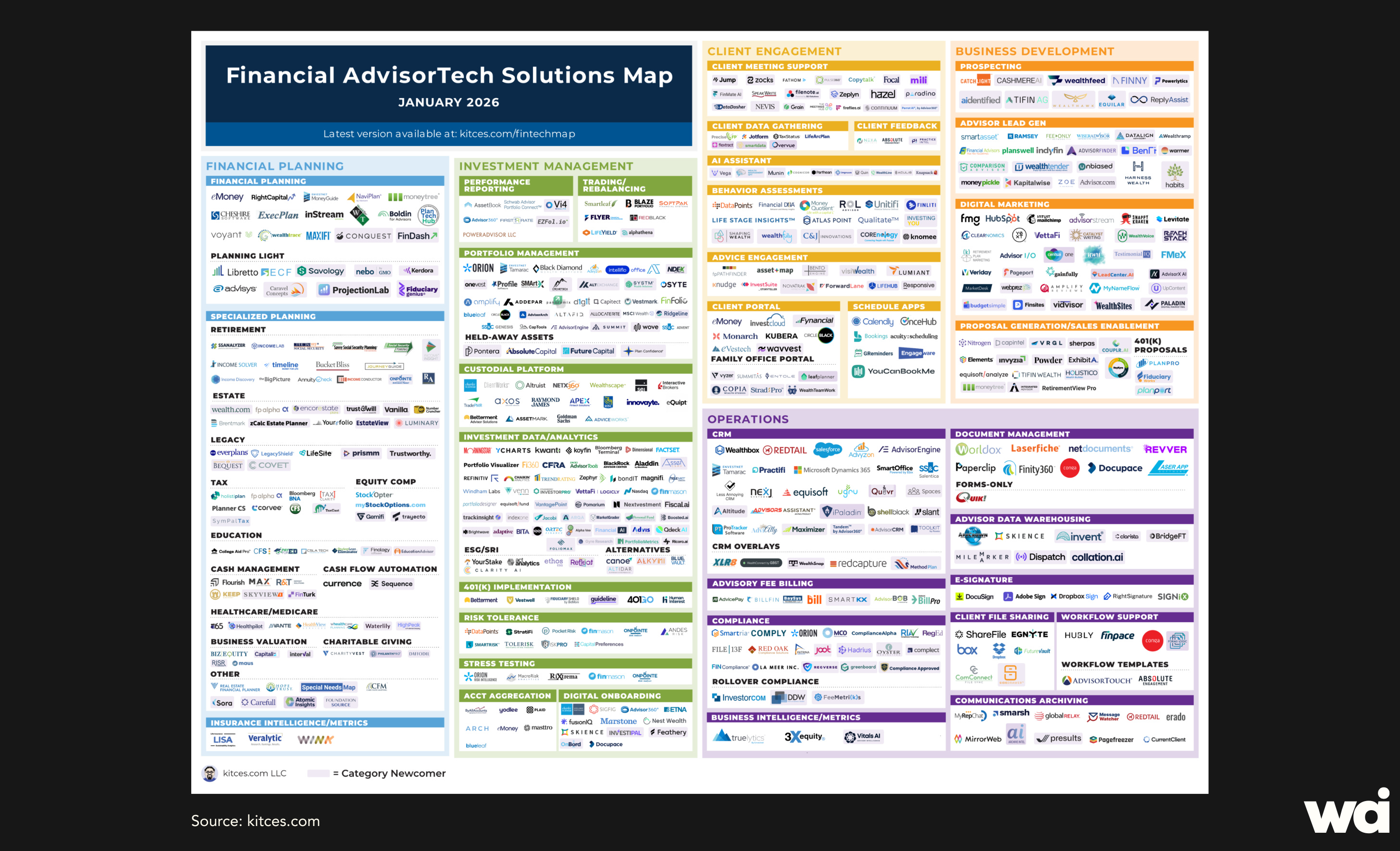
By mid-2025, the map had metastasized. Five hundred and seventy-four companies. Thirty-six categories. More than three times the vendors in seven years. By early 2026, the ecosystem had grown so unwieldy that Kitces launched a separate Advisor Services Map — nearly three hundred additional service providers that had been knocking on the door of the tech map for years. And forecasters were projecting the landscape would become fifty to a hundred percent more crowded over the following five years, driven by the plummeting cost of building a minimally viable software product.
Consider the taxonomy. Five major pillars — Financial Planning, Investment Management, Client Engagement, Business Development, and Operations — subdivided into categories that range from the foundational (CRM, Portfolio Management) to the exquisitely niche (Healthcare/Medicare, Business Valuation, Rollover Compliance, Communications Archiving/Monitoring). Sixteen subcategories in Financial Planning alone. Thirteen in Investment Management. Thirteen more in Operations. A typical advisory firm now runs twelve distinct software applications to manage twenty different business functions. Even the least technologically sophisticated firms — the ones whose idea of innovation is using DocuSign instead of a fax machine — run at least ten tools across sixteen functions.
Let those numbers settle for a moment. Twelve applications. Twenty functions. The average advisor spending four to six percent of their annual revenue on technology, maintaining a Frankenstein’s monster of a tech stack stitched together with API bridges, manual data entry, and quiet desperation.
And here is the part that should make everyone in this industry uncomfortable: it’s getting worse, not better. Of the twenty-three AdvisorTech categories directly comparable between 2023 and 2025, average satisfaction ratings fell in twenty of them. The steepest declines? Business development, digital marketing, and proposal generation — precisely the categories most susceptible to the influx of undifferentiated AI wrapper products. More tools. Less satisfaction. More noise. Less signal.
I want to give this phenomenon a name, because I think existing language fails to capture what’s actually happening. The problem isn’t just “too many vendors” or “integration challenges.” The problem is thermodynamic.
Integration Entropy
In physics, entropy is the tendency of any closed system to move from order to disorder. Drop an ice cube into a glass of warm water and watch: the organized crystal structure dissolves into a uniform lukewarm muddle. You never see the reverse — the warm water spontaneously organizing itself back into an ice cube. Entropy only goes one direction.
Something structurally identical is happening to wealth management technology stacks.
Every time an advisory firm adds a new software tool, it doesn’t simply add a tool. It adds n-1 potential integration failure points to a system that already has n existing tools. The CRM needs to talk to the portfolio accounting system needs to talk to the financial planning software needs to talk to the trading platform needs to talk to the compliance engine needs to talk to the document management system needs to talk to the client portal. Each connection is a seam. Each seam is a potential fracture. Each fracture is a place where client data gets lost, duplicated, or corrupted.
I call it Integration Entropy: the tendency of a technology ecosystem to become progressively more disordered as new tools are added, where each additional application increases the total friction of the system faster than it reduces any individual workflow bottleneck.
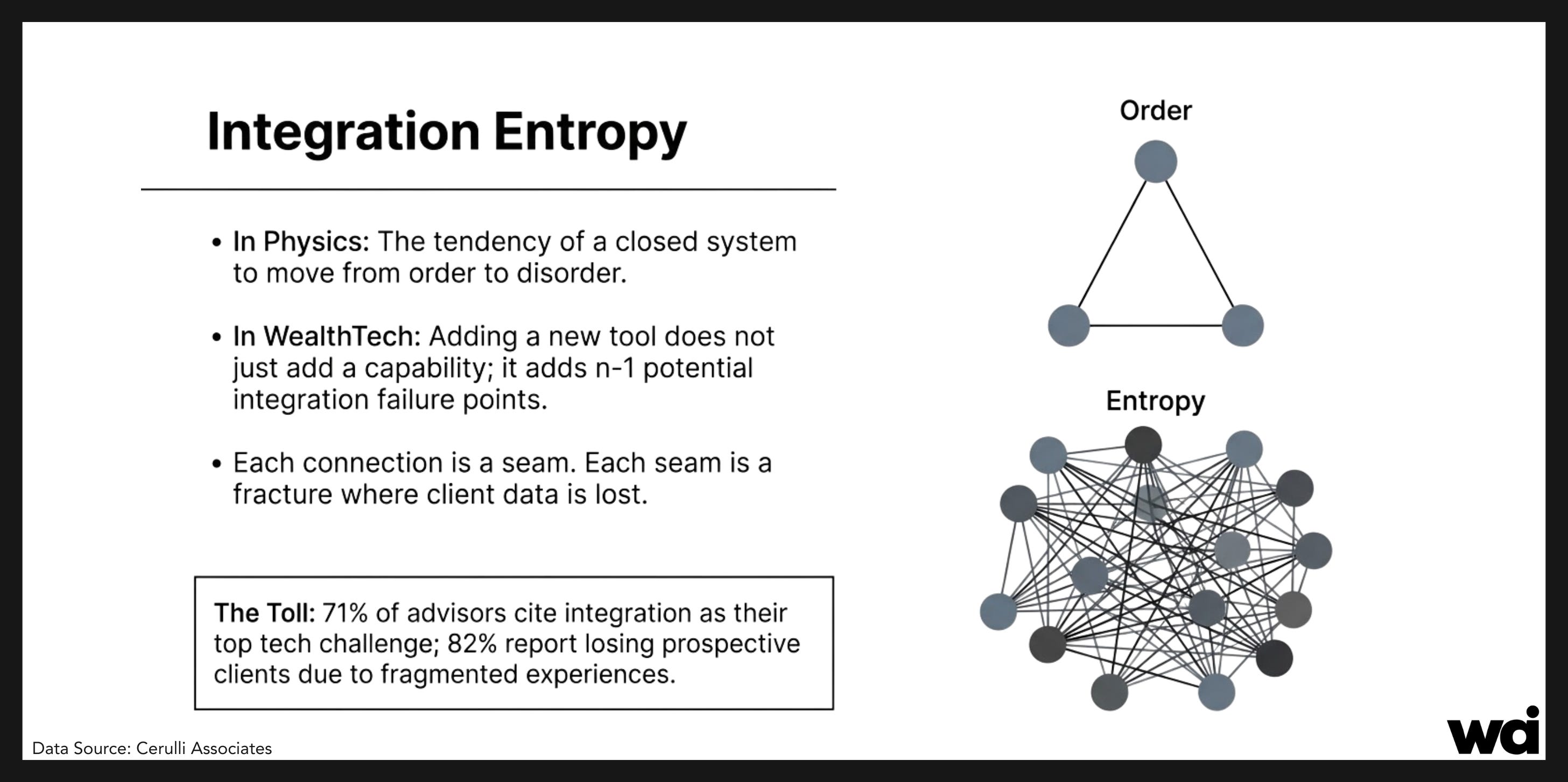
Cerulli Associates quantified the damage. Seventy-one percent of advisors explicitly cite lack of integration between tools as their top technology challenge. Eighty-two percent report losing prospective clients due to fragmented technological experiences. Sixty-seven percent report losing existing clients. The range and depth of integrations across tools is consistently the single greatest point of dissatisfaction in every channel, every practice type, every AUM tier that Cerulli surveys.
And here is where integration entropy becomes a trap with no exit: switching costs. The average advisor replaces a piece of core technology every twelve to twenty years. That’s a four to eight percent annual switch rate. Moving your CRM means migrating client data, retraining staff, rebuilding workflows, and enduring months of parallel-running systems while praying nothing falls through the cracks. Seventy-four percent of advisors rate their portfolio accounting software as “very difficult” or “somewhat difficult” to change. Seventy-one percent say the same about CRM. So advisors are locked into disordered tech stacks with no practical escape, adding new tools on top of old ones, watching entropy climb.
This is the environment into which product slop is being poured. An ecosystem already at critical mass, already drowning in friction, into which the lowest barrier to software creation in human history is now injecting hundreds of new products per year.
The Thin Wrapper Problem
To understand product slop in wealth management, you have to understand what most of these new products actually are.
They are thin LLM wrappers.
A thin wrapper is a software application that consists of little more than a user interface layered over someone else’s artificial intelligence — typically an API from OpenAI or Anthropic. The wrapper doesn’t own the underlying intelligence. It doesn’t control the computing infrastructure (which runs on hyperscalers like Microsoft Azure and Amazon Web Services, powered by NVIDIA chips). It doesn’t possess proprietary data that would give it a defensible advantage. It is, architecturally, a storefront with no warehouse — a beautiful door opening onto a room that belongs to someone else.
The AI notetaker is the canonical example. In 2024, the market was flooded with standalone meeting transcription tools aimed at financial advisors. They charged premium monthly subscriptions. They promised to “capture every client insight.” And their core technology — converting speech to text, generating summaries, extracting action items — was a commodity capability available to anyone with an API key and a weekend.
The inevitable happened. Salesforce embedded transcription into its CRM. Wealthbox followed. The standalone wrappers found their core feature absorbed into platforms their customers were already paying for. Jump, the advisor-specific AI assistant that had at least built genuine differentiation through proprietary meeting analysis, acquired the human-driven transcription service Mobile Assistant in October 2025 — a defensive consolidation move that acknowledged reality: time was running out for standalone wrappers to establish a reason to exist. By early 2026, the Client Meeting Support category on the Kitces Map — after two years of explosive growth — had begun to plateau, with signs of companies pivoting away from meeting notes or dropping off the map altogether.
The pattern isn’t limited to notetakers. B2C “robo-planning” applications attempted to use AI engines to generate financial plans directly for consumers. They fell into the same trap as the robo-advisors of the previous decade: client acquisition costs exceeding three thousand dollars per household, and a fundamental inability to provide the human contextualization that complex financial advice requires. They learned what the industry keeps re-learning at enormous expense:
AI is a feature, not a standalone product.
The numbers are brutal. Following a record surge of over fourteen thousand AI startup launches globally in 2024, approximately forty percent had shut down by early 2026. By year-end 2026, industry observers project the failure rate will reach sixty to seventy percent of the 2024 cohort. Meanwhile, venture capital deal volume has declined sharply — with funding concentrating into fewer, larger bets on established AI leaders like OpenAI and Anthropic — while hundreds of small wrapper startups find themselves locked out of follow-on funding entirely. The bubble isn’t deflating uniformly. It’s bifurcating: record billions for the biggest players, and a funding desert for everyone else.
And yet the slop keeps flowing into WealthTech. Because the barrier to creating an AdvisorTech product has never been lower — a few thousand dollars, a competent prompt engineer, and an afternoon — even as the barrier to creating one that matters has never been higher.
The Clients Don’t Want This
Here is the counterintuitive part. The part that should give every AI-first WealthTech founder a long, quiet pause.
The end clients — the actual human beings whose money is being managed — largely don’t want artificial intelligence in their financial relationships.
Cerulli Associates tracks this through their Affluent Investor Tracker, and the data is remarkably stable and remarkably bleak for AI evangelists. In 2025, only thirty-eight percent of affluent investors said they were at least somewhat comfortable with AI tools being part of their financial provider relationship. That’s essentially flat from thirty-nine percent in 2024. Two years in — two years of breathless hype, of demos with smooth animations, of startup pitches promising to “transform” and “revolutionize” — and the needle hasn’t moved.
The age gradient is steep. Sixty-one percent of investors under thirty are comfortable with AI. Sixteen percent of those over seventy. That tracks with every other technology adoption curve in history. But the more interesting data isn’t demographic — it’s behavioral.
Cerulli segments investors by how they actually engage with advice, and the pattern is brutal for the AI-first thesis. The investors most open to AI are the ones who don't yet have an advisor — younger, digitally engaged, still shopping. The vast majority of them are comfortable with AI tools. But the investors who matter most to an advisory practice — the affluent clients who have already chosen a human advisor, who place deep trust in that relationship, who want nothing to do with the mechanics of their wealth — are overwhelmingly uncomfortable with AI in their financial lives. Among the wealthiest, most loyal client segment, the ones who generate the most revenue, stay the longest, and refer the most generously, roughly a third actively reject the idea. These aren't technophobes. These are the clients every advisor most wants to keep. And they don't want the AI notetaker. They don't want the chatbot. They don't want the engagement platform. They want a human being who knows that when Julie Stevens' mother dies, the right move is to set the financial plan aside and just listen.
J.D. Power’s 2025 U.S. Investor Satisfaction Study illuminates the paradox from the other direction. Twenty-seven percent of current do-it-yourself investors say they plan to seek a human financial advisor within the next twelve months. Among Gen Y and Gen Z — the most digitally native generations, the ones supposedly destined to live entirely in app-mediated financial relationships — that number is thirty-seven percent.
Think about what this means. The generation most comfortable with AI-powered tools is also the generation most actively leaving self-directed platforms to seek human advice. Technology creates curiosity. Curiosity creates questions. Questions create the need for someone who can sit across a table and say, “Here’s what I think you should do, and here’s why.” The AI is the gateway drug. The human advisor is the drug.
The industry is building for a customer who doesn’t exist — the affluent investor who wants to delegate the full complexity of their financial life to an algorithm. What actually exists is a customer who wants technology to be invisible: running flawlessly in the background, handling the tedium, freeing the advisor to do the thing that no language model can do, which is to know a person.
The Fiduciary Filter
If market forces were the only selection mechanism, product slop might persist indefinitely — sustained by cheap capital, low barriers to entry, and the eternal optimism of founders who believe that their wrapper is different. But wealth management has something most software markets don’t: a regulatory environment that functions as biological natural selection for bad products.
The SEC and FINRA have spent the last two years establishing a framework that treats AI not as a novelty but as a standard operational risk vector subject to existing, stringent regulations. The message is simple: the rules that applied before AI still apply. And if you claim your product uses AI when it doesn’t, or if you deploy AI without adequate oversight, regulators will find you.
They already have.
In March 2024, the SEC levied a combined four hundred thousand dollars in civil penalties against investment advisers Delphia and Global Predictions for making false and misleading statements about their use of artificial intelligence. Delphia had claimed in brochures and press releases that it used AI and machine learning to analyze client data for investment decisions. It hadn’t. It had never even created the algorithm it described. Global Predictions had marketed itself as the “first regulated AI financial advisor” and promoted “AI-driven forecasts” that didn’t exist. These were the SEC’s first enforcement actions specifically targeting “AI washing” — the practice of using artificial intelligence as a marketing veneer over conventional (or nonexistent) technology.
Then came Nate. In April 2025, the SEC and the Department of Justice charged the founder and former CEO of Nate Inc. with fraudulently raising over forty million dollars by claiming the company’s shopping app used AI to process transactions. In reality, it relied on hundreds of human contractors in the Philippines manually completing purchases. The AI was people. The technology was labor arbitrage dressed in a hoodie.
The SEC’s 2026 Examination Priorities moved AI from an “emerging fintech area” to a “clear area of operational risk.” FINRA’s guidance demands that any communication mentioning AI must accurately describe the technology and balance potential benefits with associated risks. If a firm uses generative AI for summarization or information extraction, its supervisory policies must account for the integrity, reliability, and accuracy of the model.
But the true barrier to entry — the thing that will eventually kill product slop through sheer regulatory physics — isn’t the headline enforcement actions. It’s the structural compliance burden that most AI startups don’t even know exists until it destroys them.
SEC Rule 17a-4 mandates the preservation of complete and accurate compliance records. Immutable storage. WORM-compliant systems. If an advisor uses an AI tool to generate a meeting summary, and that summary is transmitted via email or CRM, it becomes a regulated record that must be indefinitely preserved and auditable. Because AI tools can hallucinate — because they can misinterpret a joke about Thanksgiving leftovers as a serious concern about food insecurity — unreviewed AI notes present a regulatory liability that most thin wrappers are architecturally unprepared to manage.
The 2024 amendments to Regulation S-P raised the stakes further. RIAs must maintain written incident response programs. They must oversee third-party service providers. They must notify affected individuals within thirty days of discovering a data breach. When Mercer Advisors suffered a breach in February 2026 exposing 5.7 million records to the threat group ShinyHunters — who gave the firm forty-eight hours to pay ransom before dumping the data on the dark web — the potential class-action liability was projected to reach nine figures. Two separate class-action lawsuits were filed within weeks. Nine figures. For a single breach. At a single firm. Because of a vendor vulnerability. And Mercer was not alone: Beacon Pointe Advisors, Pathstone Family Office, and even fintech robo-advisor Betterment all suffered breaches in the same period, underscoring that the cybersecurity threat to wealth management is accelerating, not stabilizing.
This is the fiduciary filter. The regulatory environment doesn’t just penalize bad products — it makes the existence of bad products existentially expensive. Every AI wrapper that touches client data becomes a node in a compliance network that extends from the advisor’s desk to the SEC’s examination division. Ephemeral startups built on rented intelligence and minimal infrastructure cannot survive this weight. They are ice cubes dropped into warm regulatory water.
Entropy wins.
What Isn’t Slop
It would be cynical — and wrong — to suggest that all AI-enabled wealth management technology is slop. Cynicism is surrender. The point of naming slop is to distinguish it from the things that genuinely matter.
What distinguishes the companies that survive the fiduciary filter from the ones that dissolve? A concept as old as medieval fortification: the moat.
Consider a wealth data platform that manages more than eight trillion dollars in assets, with forty percent concentrated in alternatives. The complexity of private equity, real estate, and hedge fund data — delivered via PDF K-1 statements and capital call notices, formatted differently by every fund administrator on earth — defeats generic AI wrappers the way a stone wall defeats a battering ram made of cardboard. This platform built its moat through a proprietary data lakehouse that extracts, validates, and integrates alternative data at scale. It acquires AI workflow companies not to slap a chatbot on a dashboard, but to embed machine learning deeper into an architecture that took years to build. This is not a weekend project. This is not an API call. This is structured domain expertise encoded in infrastructure that cannot be replicated by prompting a language model.
Another company took a more radical approach. Rather than building software that sits on top of existing custodial infrastructure, it built the custodial infrastructure itself. A digital-first, self-clearing custodian built exclusively for independent advisors, with fee billing, performance reporting, and digital account opening embedded natively into the custody platform. No API bridges. No integration seams. No entropy. The integration crisis eliminated entirely through first-principles architecture.
A third — operating in the brutally competitive AI meeting-notes space that has claimed so many wrapper casualties — survived by doing something most competitors didn’t: building a data moat from the conversations themselves. By analyzing tens of thousands of anonymized advisor-client meetings, it extracted proprietary behavioral insights. Tax planning appeared in the vast majority of meetings and correlated with significantly higher client sentiment. Its proprietary sentiment and emotional intelligence scores — measuring talk-time ratios, objection handling, emotional tenor — proved more predictive of product acceptance than traditional demographic and portfolio data. And critically, it ring-fences its architecture: no client data trains its overarching AI models. The intelligence is proprietary and the data is sacrosanct.
The market is voting for these kinds of platforms, and the ballot isn’t subtle. Advisors now use an average of 2.0 primary platforms, down from 2.2 in 2024. They direct seventy-one percent of new client flows to their primary platform. They are choosing less. One quiet all-in-one platform has roughly tripled its market share across multiple categories by providing native portfolio management, reporting, and CRM without the need for fragile integration bridges. A major technology provider surpassed five trillion dollars in assets under administration and announced a direct collaboration with a leading AI foundation model company — integrating frontier capabilities into an established advisor platform, rather than creating yet another standalone wrapper. Another retired an entire sub-brand to unify its offerings under a single umbrella, in an explicit bid to reduce workflow friction.
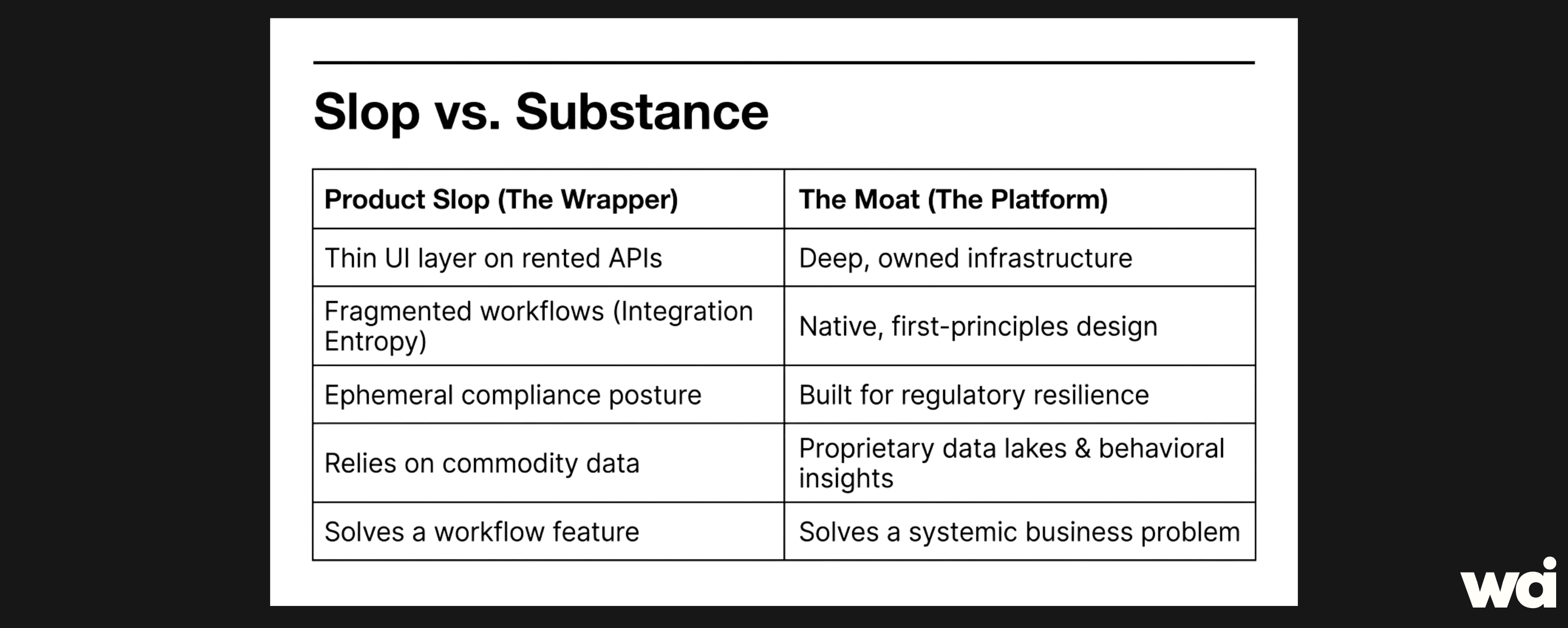
The signal is unmistakable. The industry isn’t consolidating because it’s tired of innovation. It’s consolidating because it’s exhausted by fragmentation. It doesn’t want more products. It wants fewer, better ones. It wants moats, not wrappers. Depth, not surface area. Things that work, not things that demo well.
Coda
She’s still there. Our advisor, the one who closed the demo tab at 9:07 on a Tuesday. She didn’t close it because she’s afraid of technology. She runs twelve applications, same as everyone else. She uses a CRM, a financial planning suite, a portfolio accounting system, a trading platform. She’ll probably adopt AI-enhanced tools over the next few years — tools that draft documents faster, that catch data entry errors, that surface patterns in client portfolios she might otherwise miss.
But she will never adopt a tool that doesn’t understand the difference between what can be automated and what must be felt. Between a meeting transcript and a relationship. Between the map and the territory.
Julie Stevens’ estate plan will get done. The advisor will run the projections, model the trust structures, optimize the tax implications. She’ll use software for all of it. But first, she’ll call Julie. And for the first ten minutes of that call, she won’t mention money at all.
This is what product slop cannot replicate. Not because the technology isn’t sophisticated enough — it will get there, eventually, in some crude approximation — but because the act of choosing not to optimize, of deliberately leaving space for silence, for grief, for the unquantifiable weight of a ninety-six-year-old woman who remembered you as a child — that is a fiduciary act. It is the ultimate expression of putting the client’s interest above your own efficiency metrics.
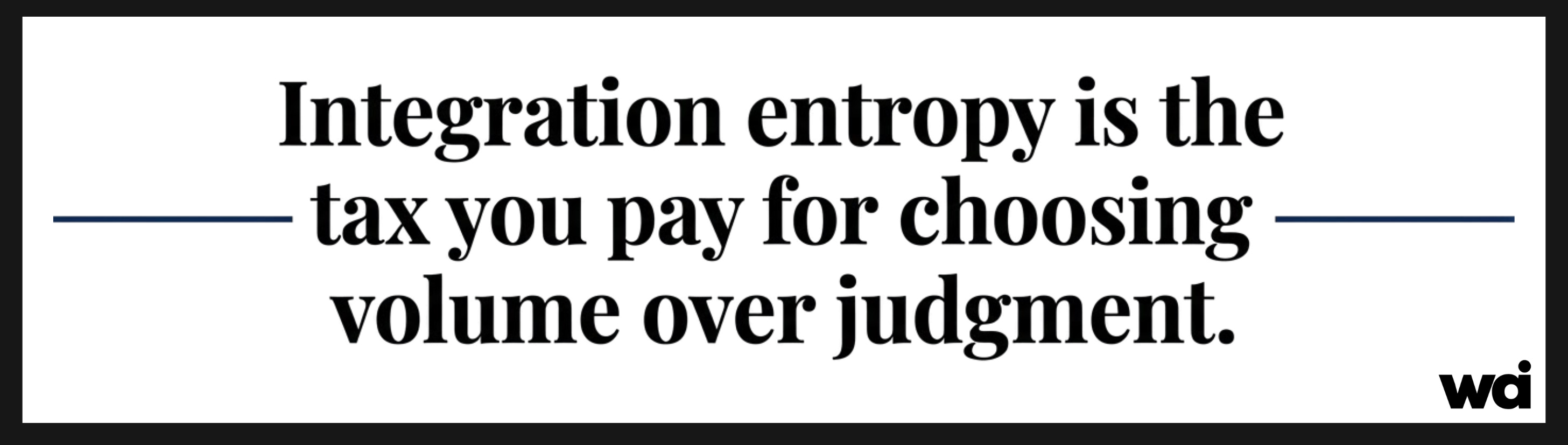
The wealth management industry doesn’t have a technology problem. It has a taste problem. Integration entropy is the tax you pay for choosing volume over judgment. The fiduciary filter will eventually kill the slop — but not before it wastes billions of dollars, thousands of advisor-hours, and an immeasurable quantum of client trust on products that were good enough to ship but never good enough to matter.
Nearly six hundred companies on the map. Twelve tools on every desk. Thirty-eight percent investor comfort with AI. And one advisor, on a Tuesday morning, closing a tab.
The question was never whether AI would transform wealth management. It will. The question is whether we have the discipline — the old, unglamorous, profoundly human discipline of fiduciary care — to demand that the transformation be worth something. To insist that in an era when anyone can build a product in an afternoon, the measure of a product isn’t that it was built, but that it was needed.
Slop is easy. Substance is not. The industry’s future depends on knowing the difference.
Disclosure. I have no commercial relationship with OpenAI, Anthropic, Google, or any AI vendor mentioned in this article. If you think I’m wrong about any of it, I genuinely want to hear it — the comments section exists for a reason.
Disclaimer: The views and opinions expressed in this article are strictly my own and are written in a personal capacity. They do not reflect the official policy, position, or views of my current employer, The Vanguard Group Inc., or any of its subsidiaries or affiliates.