


With AI moving this fast, just keeping up with the news is hard. Understanding what it means for WealthTech and Wealth Management is even harder. I want to help.
Welcome to "Last Two Weeks in AI." Every two weeks, I'll share the most interesting updates. Some topics get technical, but I'll always break them down to their real-world impact on our industry. This is part one. I hope you enjoy it.
The United States will be short 110,000 financial advisors by 2034. That’s not a typo. It’s 37% of the current workforce — vanishing to retirements that outpace new hires by a widening margin every year.
At the same time, $84 trillion in assets is about to change hands. The largest intergenerational wealth transfer in human history. And the next generation of inheritors doesn’t want what their parents got. They want personalized estate planning, Real-time tax optimization, Proactive risk management across their full household balance sheet. They want an advisor who knows them, remembers them, and works around the clock.
The industry has a name for the solution: the “Firm of One.” A single human advisor augmented by dozens — eventually hundreds — of specialized AI agents. The agents handle the quantitative heavy lifting. The human handles the moments where empathy, judgment, and trust matter.
It’s an elegant concept. It has also been impossible to build. Until, arguably, this year.
The Bottleneck You’re Not Seeing
If you’ve been tracking AI progress, you probably assume the barrier to deploying autonomous agents in high-stakes domains is intelligence. The models aren’t smart enough. They hallucinate. They can’t reason over complex documents.
That narrative is wrong.
Frontier models in 2026 can hold a million tokens in context. They can reason across documents that would take a human analyst weeks. The raw cognitive power is there.
The real barrier is memory.
Not metaphorical memory. Engineering memory. The ability to hold, retrieve, and persist the right information at the right resolution across the right timescales. Every time an AI agent breaks down on a real-world financial task — missing a regulatory clause, forgetting a client’s risk profile between sessions, garbling a statute reference — you’re not watching an intelligence failure.
You’re watching a memory failure.
There are exactly three kinds.
Failure #1: The Scratch Pad Overflows
When an AI model processes a conversation, it stores mathematical traces of everything it has thought about in a high-speed memory buffer called the Key-Value cache. Think of it as the AI’s working scratch pad.
The problem: this scratch pad grows in direct proportion to conversation length and the number of simultaneous users. Financial work demands long, dense analysis — parsing a 200-page trust document, cross-referencing tax codes. The scratch pad devours more GPU memory than the model itself. You hit a physical wall.
Previous attempts to compress this buffer were crude. Traditional methods stored tiny correction factors alongside the compressed data. The overhead from those correction factors canceled out the savings — like packing a suitcase more tightly but needing a second bag for the packing instructions.
Last week, a team at Google Research published latest results of their TurboQuant algorithms. It compresses the AI’s scratch pad to 3 bits per element. That’s a 6x reduction in memory and up to 8x faster processing on modern GPUs.
The quality loss? Zero.
On the “Needle-In-A-Haystack” test — where a model must find a single hidden sentence in over 100,000 tokens of noise — TurboQuant at 4x compression matched the uncompressed model perfectly.
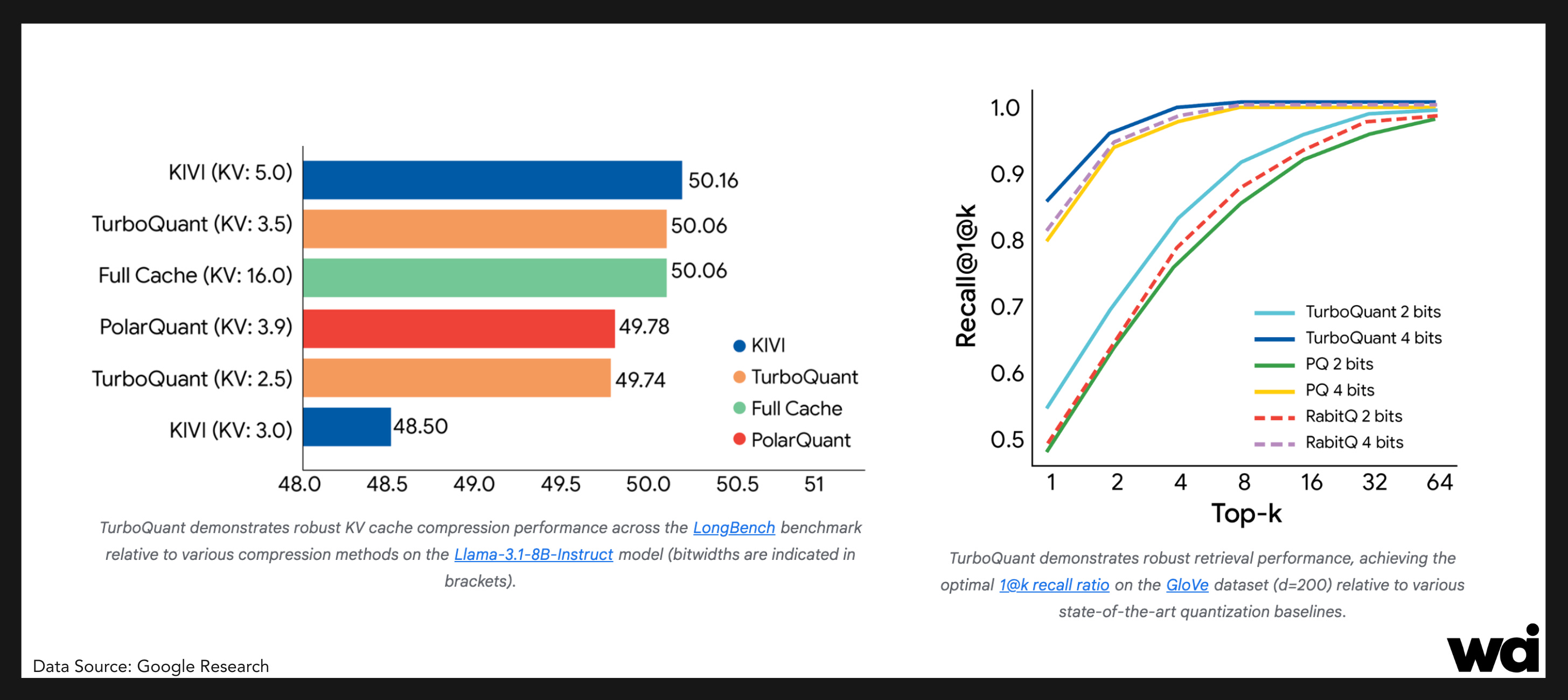
The mathematical trick is elegant. Instead of storing expensive correction factors, TurboQuant applies a random rotation to the data vectors. A property of high-dimensional geometry called concentration of measure forces the rotated data into a predictable statistical shape. Because the shape is known in advance, the system applies pre-computed compressors without storing any per-block metadata.
The kicker: the algorithm’s compression rate sits within a factor of 2.7 of the absolute theoretical limit Claude Shannon established in 1959. Shannon defined the minimum possible distortion for any compression scheme. TurboQuant nearly reaches it — with no offline training, no calibration data, in sub-millisecond latency.
The scratch pad problem is solved.
Failure #2: Retrieval Corrupts the Answer
The industry’s standard workaround for models that can’t hold everything in their head is Retrieval-Augmented Generation — RAG. Chop your documents into chunks, convert them to mathematical vectors, and retrieve the most relevant chunks when a question comes in.
The 2026 consensus: naive RAG is broken for precision-critical work.
The failure mode is almost embarrassing. When you slice a financial document at arbitrary token intervals, the chunks lose their context. A chunk that reads “revenue grew by 3%” is useless if the paragraphs identifying which company and which quarter landed in a different chunk. The retrieval system returns the chunk with the highest statistical similarity — which often isn’t the chunk with the actual answer.
In financial services, this isn’t a minor annoyance. It’s the difference between “the trust designates Beneficiary A” and “the trust designates Beneficiary B.” It’s the difference between citing the right tax statute and citing the wrong one.
Anthropic’s fix — Contextual Retrieval — is almost offensively straightforward. Before chunking, a language model reads the entire source document and writes a short summary (50–100 tokens) that situates each chunk within the full document. This summary gets prepended to the chunk before indexing.
The enriched chunks then flow through two parallel retrieval paths: semantic search (for meaning) and BM25 lexical search (for exact keyword matches). You need both. Semantic search understands intent. Lexical search finds “IRC § 1031” or “CUSIP 037833100” — the precise alphanumeric identifiers that semantic models routinely confuse.
The result: a 67% reduction in retrieval failures — from a 5.7% failure rate to 1.9%.
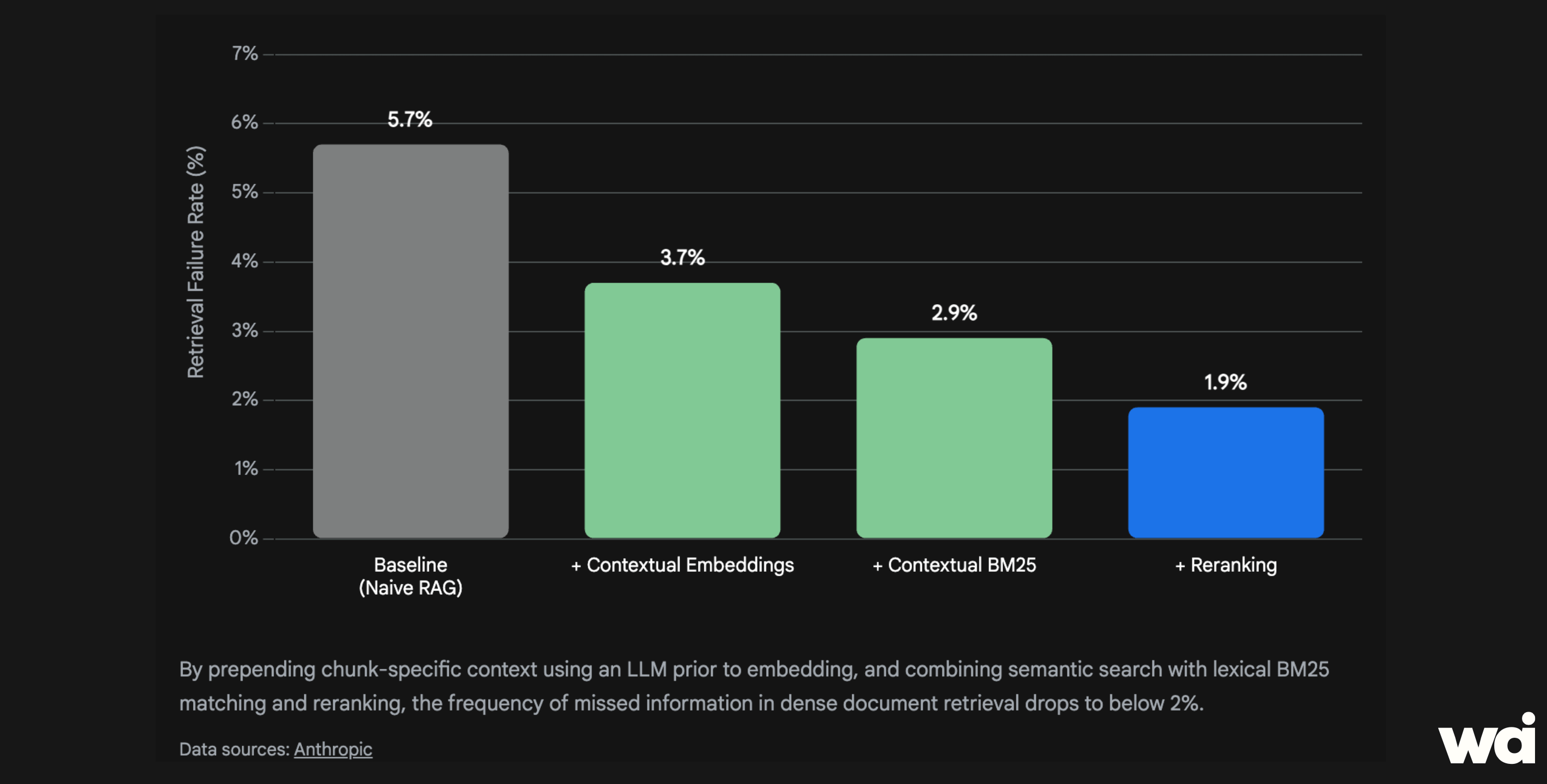
In a compliance-critical domain, going from 94.3% accuracy to 98.1% isn’t incremental. It’s the line between a deployable system and a liability.
Failure #3: The Agent Forgets Everything
This is the one almost nobody talks about. It’s arguably the most damaging.
Complex financial tasks — restructuring an estate plan, integrating a post-merger database, running a multi-week compliance audit — take longer than a single AI session. At some point, the model hits its token limit or the API times out. The session resets.
When the agent wakes up again, it has no idea what happened before. Complete digital amnesia. Whatever analysis it had done, whatever patterns it had spotted, whatever instructions it had been following — gone.
Two parallel solutions emerged in 2026.
Google’s Memory Bank is a persistent storage system that extracts the most important facts from each conversation — changes in risk tolerance, upcoming liquidity events, family dynamics — and consolidates them into a structured, evolving profile. When a new session begins, the agent queries this memory store instead of replaying raw conversation logs. The profile evolves over time without manual data entry. Stale data gets purged through configurable expiration policies.
Anthropic’s long-running agent harness takes a different, more architectural approach. Researcher Prithvi Rajasekaran built a three-agent system — Planner, Generator, Evaluator — designed to sustain coherent work across multi-hour (and eventually multi-day) autonomous sessions.
The insight that unlocked it: AI agents are terrible at evaluating their own work. When asked to assess their output, they praise it — even when it’s mediocre. Rajasekaran separated generation from evaluation, borrowing from the adversarial dynamics of GANs.
The results speak in dollar amounts. Given a one-sentence prompt to build a Digital Audio Workstation:
A single unsupervised agent produced output in 20 minutes for $9. Technically functional. Practically broken.
The three-agent harness ran for 4 hours, cost $124.70, and delivered a working music production program with arrangement views, a mixer, and an AI agent that could compose songs through natural language.
The evaluator caught failures the generator would have shipped: features that were display-only stubs, audio recording that silently did nothing, UI elements that looked interactive but weren’t wired up.
Quality didn’t come from a smarter model. It came from friction between specialized agents.
The Stack That Makes Agents Real
Here’s the mental model worth keeping.
Every AI agent that operates in a complex, real-world domain needs three kinds of memory working at once:
Short-term memory — the working scratch pad. TurboQuant compresses it by 6x with zero quality loss. Google’s implicit context caching cuts recurring token costs by up to 90%. Solved.
Knowledge memory — the document retrieval layer. Contextual Retrieval reduces failure rates by 67%. The Model Context Protocol standardizes secure access to external databases and systems. Almost Solved — or close enough for production.
Long-term memory — the persistent identity across sessions. Memory Bank maintains evolving client profiles. Long-running harnesses externalize agent state into structured files and version control. Solvable — and improving fast.
Every failed AI agent deployment maps to a breakdown in one of these three layers. The compliance bot that misses an update? Knowledge memory. The advisor tool that re-asks a client’s risk tolerance every call? Long-term memory. The document analyzer that chokes on a 200-page filing? Short-term memory.
This is the diagnostic framework. Use it before you blame the model.
What This Means for the Next Five Years
The wealth management industry is the canary in the coal mine — but the implications extend to any domain where decisions compound over time and context stretches across sessions.
The numbers for wealth management alone are stark:
50% faster client onboarding through automated KYC/AML
40–50% reduction in portfolio management operational costs
Estate planning — historically reserved for clients with eight figures — made viable for the mass-affluent market through agents that can parse hundreds of pages of legal documents with near-perfect recall
But the deeper shift is in what gets supervised. When agents execute trades, modify risk profiles, and rebalance portfolios, the nature of enterprise risk changes. The question stops being “did the model give a wrong answer?” and becomes “did the model do a wrong thing?”
This demands forcing all agent actions through standardized, auditable protocol layers — which is what the Model Context Protocol was built for. “Policy as code” replaces “policy as memo.” Human checkpoints get hardcoded into high-risk pathways. The agent asks permission not because it wants to, but because the architecture won’t proceed without it.
The Real Moat
The competitive advantage in AI is shifting. Models are commoditizing. The next version of every frontier model will be smarter, cheaper, and faster than the last. Training is a shrinking source of differentiation.
The moat is the memory stack.
The firms that build the right architecture — compressed short-term memory, contextual knowledge retrieval, persistent long-term identity — will deploy agents that work in production. Everyone else will keep building demos that impress in a conference room and fail in a client meeting.
The models can already mimic thinking. The question that determines who wins the next decade is what they can remember.
Disclosure. I have no commercial relationship with OpenAI, Anthropic, Google, or any AI vendor mentioned in this article. If you think I’m wrong about any of it, I genuinely want to hear it — the comments section exists for a reason.
Disclaimer: The views and opinions expressed in this article are strictly my own and are written in a personal capacity. They do not reflect the official policy, position, or views of my current employer, The Vanguard Group Inc., or any of its subsidiaries or affiliates.