


Last Tuesday, I watched my friend try their company’s new AI copilot draft a client memo in eleven seconds. Then he spent forty-five minutes rewriting it.
Not because the draft was bad, exactly. The sentences were grammatically pristine and the structure was logical. But the AI had hallucinated a regulatory citation, misattributed a data point to the wrong quarter, and opened with a tone so cheerfully inappropriate it would have made the client question whether my friend’s company truly understood the severity of their situation. So he sat there, deleting and retyping, an overpaid editor for a system that was supposed to set him free.
I mentioned this to another friend. She laughed, the tired laugh of recognition. “I saved two hours yesterday,” she said, making air quotes around saved. “Then I spent an hour and a half checking its work and twenty minutes explaining to my manager why the output still needed edits.” She paused. “I think I actually lost time.”
This is a small story, but it reflects a much larger phenomenon.
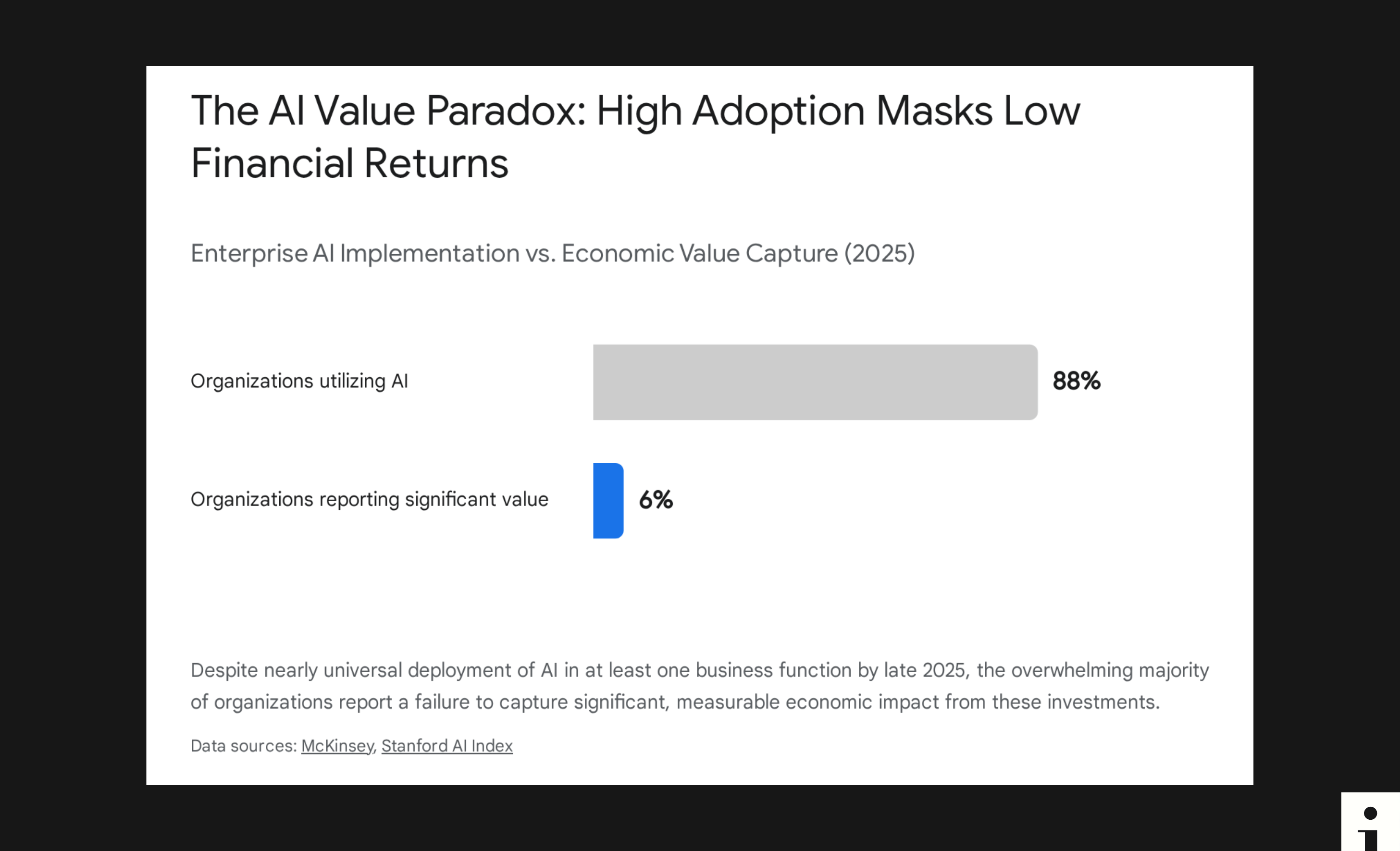
Right now, 88 percent of corporations have deployed generative or agentic AI in at least one business function. Yet only a small minority qualify as high performers, and barely 39 percent report measurable financial impact at the enterprise level. Practically, every major company on earth has bought the technology. Few are scaling real economic value from it.
The National Bureau of Economic Research surveyed nearly six thousand CEOs and senior finance managers across the U.S., the U.K., Germany, and Australia. Eighty-nine percent reported zero impact on labor productivity over the past three years due to AI. Across all firms surveyed, the estimated average productivity boost was a statistically negligible 0.29 percent, far below the 1.4 percent those same executives forecast for the next three years.
Economists have a name for this. They’re calling it the new Solow Paradox, a direct echo of the economist Robert Solow’s famous 1987 observation that “you can see the computer age everywhere except in the productivity statistics.” In the 1980s, every company bought computers but nobody reorganized their work to actually use them. The machines sat on desks running spreadsheets that people then printed out and filed in cabinets. We are doing the exact same thing with AI.
But here’s what makes this moment genuinely dangerous rather than merely wasteful: the gains aren’t absent. They’re just radically concentrated. PWC data shows that 74 percent of all economic value generated by AI is being captured by just 20 percent of organizations. It’s a massive winner-take-all dynamic, and the line separating the winners from the losers isn’t talent, budget, or access to better models.
It’s architecture.
The root of the paradox is a collision between two fundamentally incompatible logics. Legacy enterprise systems are deterministic: one input always produces one predictable output. AI is stochastic: it operates on probability, essentially guessing the next most likely action based on a vast distribution of statistical weights.
When companies inject probabilistic intelligence into a deterministic workflow, they don’t solve the workflow’s problems. They create a faster mess. The existing inefficiencies don’t disappear; they get institutionalized at a much higher computing cost.
Let me offer an image that captures this better than any technical explanation. Imagine buying a state-of-the-art Formula One engine and bolting it onto a nineteenth-century wooden horse-drawn carriage. The engine works flawlessly, firing on all cylinders, generating enormous power. But the carriage rattles to pieces the instant you hit the gas. You aren’t winning any races. You’re just destroying your infrastructure at tremendous expense.
Actually, this understates the danger. It’s not merely that the carriage falls apart. The AI actively breaks the legacy system’s compliance guardrails, its validation rules, its carefully constructed regulatory scaffolding. You aren’t just losing a race. You’re driving into a brick wall.
The 20 percent of companies succeeding with AI understand this. They aren’t buying a faster engine for the old carriage. They’re building an entirely new vehicle, designed from the ground up around what the engine can do.
There is a tempting counterargument here, and I want to address it honestly because I’ve made it myself.
Saving time feels like a victory. If an AI tool drafts my emails faster, summarizes a fifty-page PDF in seconds, or generates a first pass at a financial model, surely that’s worth something. How can saving me two hours a day be a bad thing?
The answer is that saving time is economically meaningless unless it is structurally converted.
This is the fatal flaw of the “hours saved” metric that software vendors love to sell. If a company gives you a tool that saves you two hours a day, what actually happens to those two hours? If you’re honest (and the data suggests most of us should be), you take a longer lunch. You scroll your phone. You do your remaining work at a slightly more relaxed pace. The company just bought an expensive enterprise license and is paying cloud compute tokens every time you prompt the AI. In return, they got a slightly more relaxed employee.
Wonderful for your mental health. Catastrophic for the balance sheet.
The research calls this invisible slack. Unless the freed capacity is explicitly redirected (more clients assigned, structural cost reductions implemented, net new revenue generated), the AI is just creating hidden leisure and a bloated IT budget. You really are paying Formula One prices for a carriage ride.
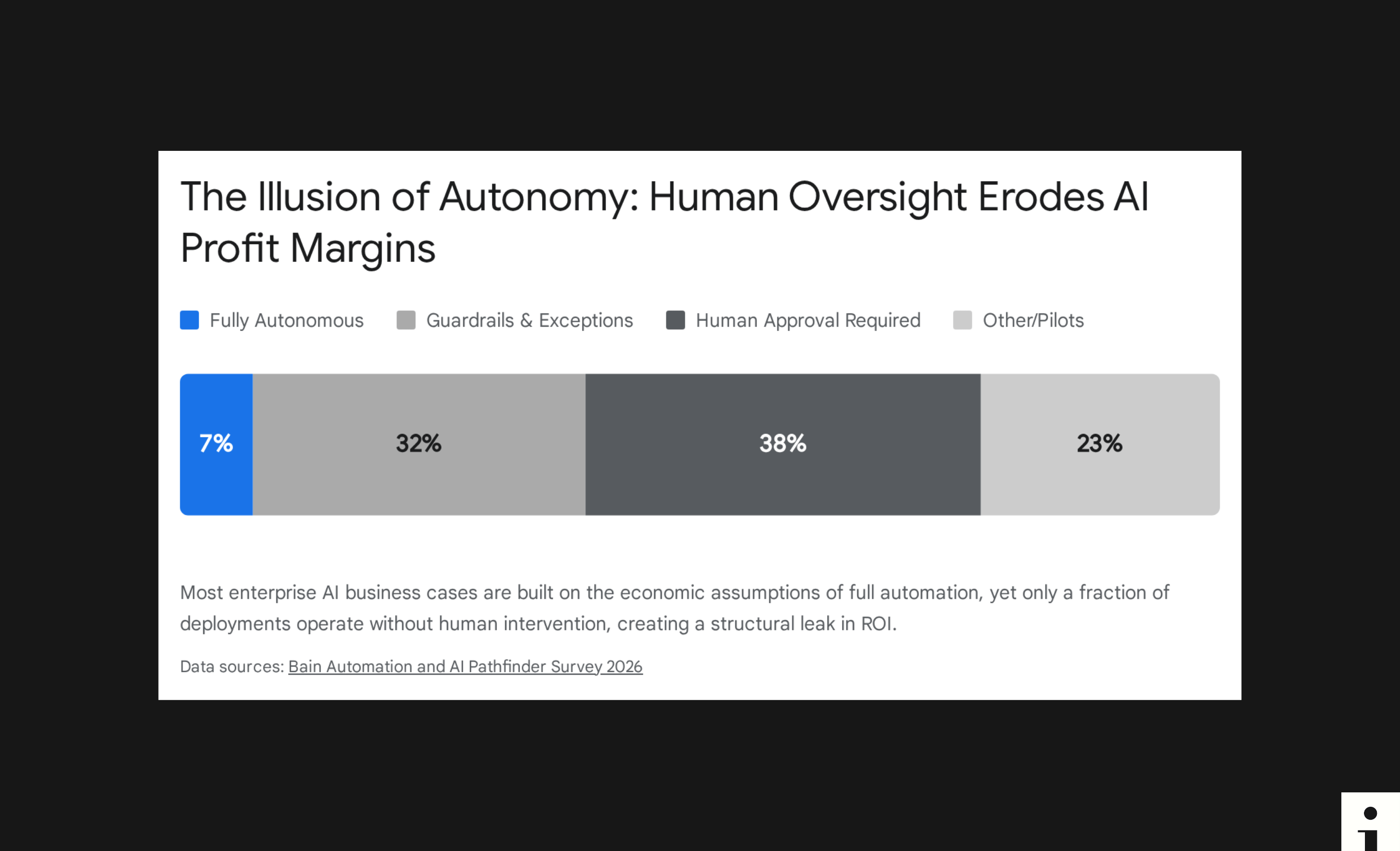
Bain’s 2026 survey of 951 global companies confirms the pattern. Thirty-seven percent targeted cost reductions of 11 to 20 percent with their AI initiatives. When Bain measured the actual outcomes, nearly 40 percent of those same companies landed in the 0 to 10 percent bracket. And only 7 percent of companies are running fully autonomous AI in production. Seventy percent of companies operate with either mandatory human approval or rigid guardrails and exception handling. In the vast majority of organizations, the AI does its work and a human still has to sit there, review it, and sign off. The human bottleneck hasn’t been removed. It’s just been renamed from “creator” to “editor.”
If the problem is the carriage, the deterministic legacy architecture, does the solution require tearing down the entire barn and starting from scratch?
It’s a terrifying question for any CEO. The idea of ripping out a thirty-year-old core banking system or a monolithic hospital records platform sounds like a suicide mission. The research confirms that it usually is one. The evidence from 2025 and 2026 completely rejects the wholesale “rip and replace” approach. Attempting to rebuild a legacy mainframe creates security vulnerabilities, causes massive operational downtime, and burns through capital before a single AI model is even trained. In commercial biopharma, where companies tried to force AI onto fragmented legacy data systems, Veeva found that 89 percent failed to scale most of their AI initiatives past the pilot stage. Not because the AI wasn’t intelligent enough, but because 96 percent of executives admitted their data simply wasn’t ready for it.
The winning companies pursue something subtler: progressive rewiring. Rather than demolishing a hundred-year-old house to access the wiring inside the walls, they install a centralized smart home hub that communicates with the old electrical grid through smart plugs. A decoupled data and orchestration layer sits above the legacy systems, translating their rigid deterministic outputs into something the probabilistic AI can actually process, and vice versa.
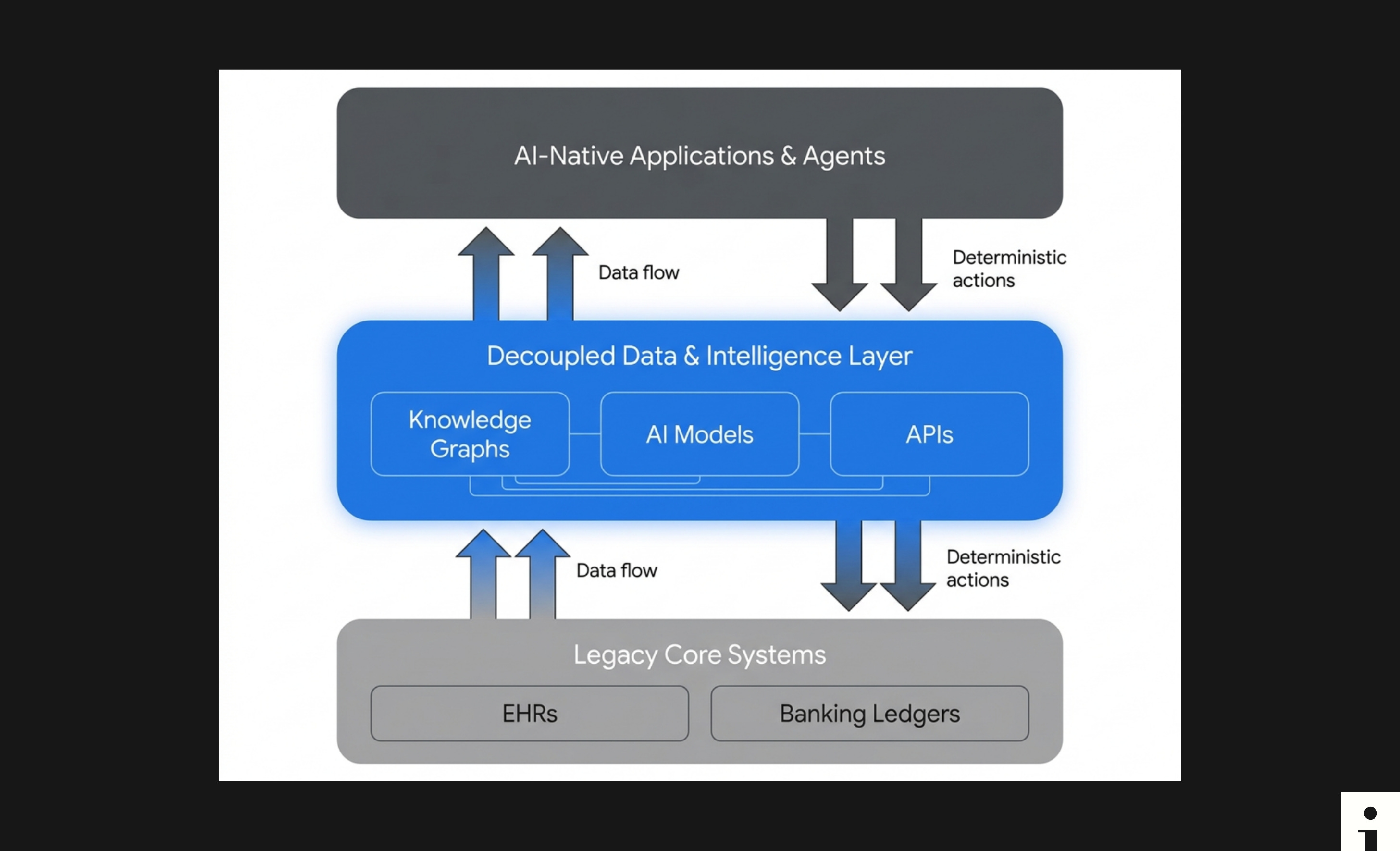
But this translation only works if the underlying data follows what researchers call FAIR principles: findable, accessible, interoperable, reusable. Without standardized metadata, without clean APIs, without common ontologies that let different databases speak the same language, the smart hub is useless. Half the wires in the old house speak Spanish. The other half speak Morse code. Without a translator, the most sophisticated AI on earth will just hallucinate.
Even Microsoft may have learned this lesson. In late 2025, The Information and Reuters reported that the company quietly reset enterprise sales expectations and trimmed Copilot quotas, though Microsoft disputed the characterization. What was harder to dispute was the pattern emerging from customers: organizations bought the licenses but struggled to operationalize the tools, reportedly because their internal data wasn’t structured for AI consumption. The model was fine. The plumbing, was broken.
The starkest illustration of where architecture succeeds and fails comes from healthcare, where the stakes are measured not in quarterly earnings but in human lives.
The Permanente Medical Group deployed generative AI scribes across more than 2.5 million patient encounters. The AI listens to the conversation between doctor and patient, then automatically drafts the clinical note, mapping medical terms to standard ontologies, formatting the output into the required structure, and pushing it directly into the legacy electronic health record through standardized APIs. In a single year, physicians saved an estimated 15,791 hours of documentation time. It significantly reduced what the industry calls pajama time: the all-too-common ritual of doctors charting patient notes at nine o’clock at night in their pajamas because the administrative burden had consumed their entire workday.
The Cleveland Clinic onboarded four thousand clinicians in fifteen weeks. Abridge, one of the leading scribe platforms, secured a $5.3 billion valuation.
Why did this succeed so spectacularly when pharma AI crashed and burned? Because the scribe respects a single, non-negotiable boundary: it lacks clinical decision-making authority. The AI doesn’t diagnose. It doesn’t prescribe. It passively summarizes what already happened in the room. The physician still reviews the draft, edits it, and signs it. The diagnostic authority and the medical liability never shift to the machine. It removed a massive administrative burden without touching the foundational governance of medicine.
Now consider what happens when that line is crossed.
UnitedHealthcare is facing a major class action lawsuit alleging that a predictive algorithm called nH Predict issued systematic blanket denials for post-acute care for Medicare Advantage patients. According to the plaintiffs, the algorithm established an average recovery curve from historical data, set a rigid algorithmic clock, and cut off payment when the clock ran out, regardless of the patient’s actual condition, frequently overriding the medical judgment of treating physicians. UHC disputes these characterizations, but the core allegation is damning: that an algorithm acted with the authority of a doctor without the context, the nuance, or the accountability.
The consequences have been devastating. Judges issued massive discovery orders demanding internal emails from UHC’s AI governance boards. Major health systems began dropping Medicare Advantage plans entirely because their doctors refused to spend hours arguing with a black-box algorithm. The brand damage alone may prove irreparable.
The ambient scribe and the payer algorithm are both AI, but the comparison reveals something more important than their technical differences. One augmented human authority. The other attempted to replace it. One generated billions in value. The other destroyed it. The dividing line was where the liability sat.
If healthcare reveals the boundary between augmentation and overreach, wealth management reveals something even more radical: AI as a complete business model mutation.
Historically, wealth management rested on a single premise: the irreplaceable human relationship. A skilled advisor could maintain meaningful, personalized relationships with roughly 150 clients, a ceiling that corresponds to what sociologists call Dunbar’s number, the cognitive limit on stable social bonds. If a firm wanted more clients, it hired more advisors. This made it economically irrational to serve anyone who wasn’t already wealthy. The cost to serve a middle-class investor simply exceeded the revenue they could generate.
AI obliterated that ceiling.
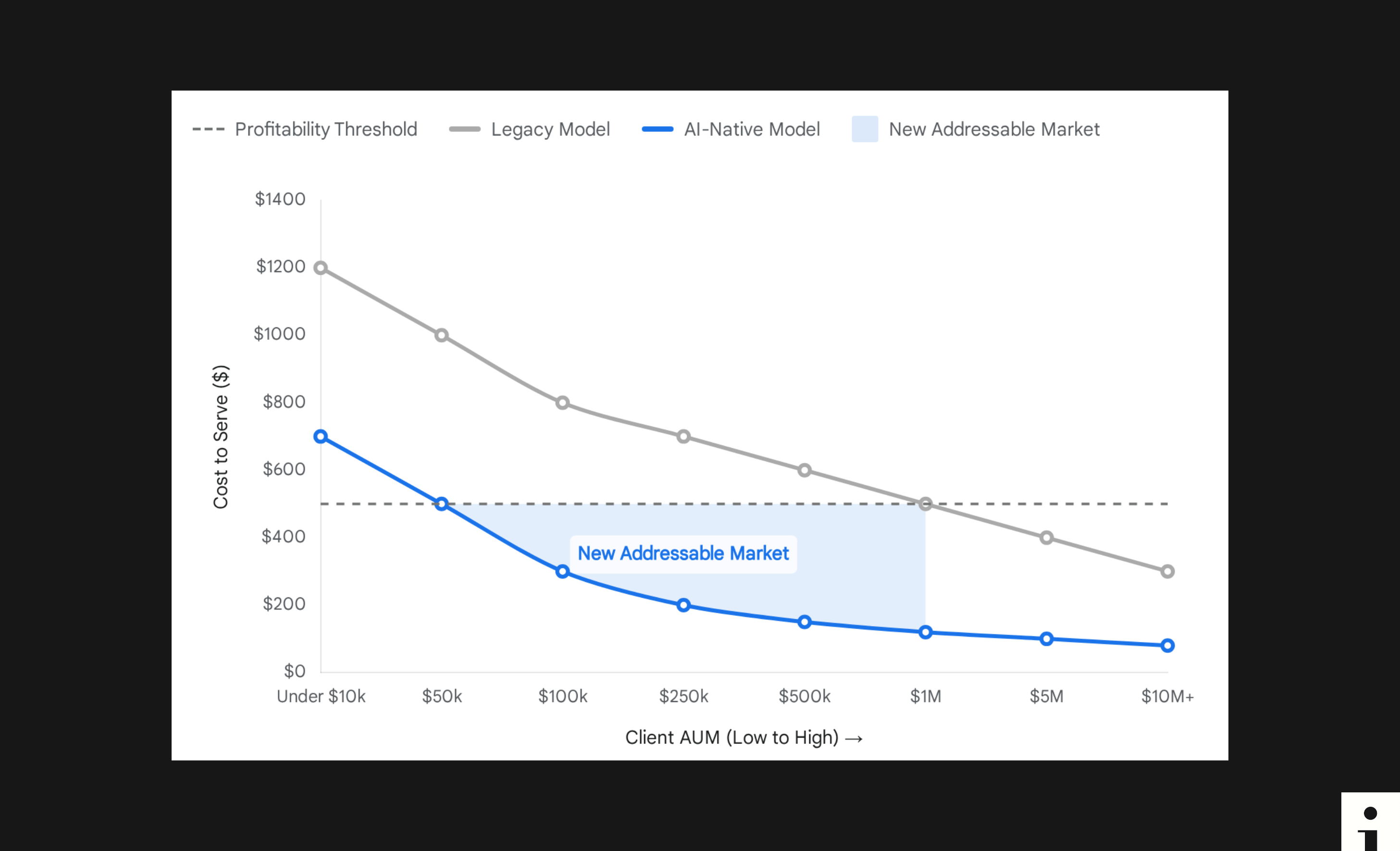
Altruist, a wealth management platform, built a tool called Hazel AI that digests a client’s tax forms, pay stubs, and custodial data, runs scenario modeling on retirement trajectories, and generates personalized tax strategies in minutes. Work that once consumed hours of manual preparation now takes minutes of review. Suddenly, it is profitable to manage the money of someone who isn’t a millionaire. The advisor isn’t replaced. They’re given an invisible, hyper-efficient back office that lets them serve far more clients with the same intimate care they once reserved for a hundred and fifty.
Vanguard pursued a parallel logic with its Digital Advisor, offering algorithm-driven portfolio management at advisory fees as low as 0.15 percent, while separately building AI-powered tools to help its human advisors deliver more personalized guidance. Morgan Stanley made an even bolder move: in 2026, they began opening portions of their platform, starting with their ShareWorks and Equity Edge stock-plan services, to external third-party AI agents, recognizing that the language model itself is a commodity anyone can buy, but their massive repository of client transaction history and compliance infrastructure is not. They stopped trying to be the best AI. They started becoming the operating system of wealth.
McKinsey confronted the paradox from the other side. Their internal AI assistant, Lilli, processes over 500,000 prompts per month. Consultants report saving up to 30 percent of their time searching for and synthesizing knowledge. But consulting is built on the billable hour. If AI compresses 30 percent of the cognitive labor, the traditional hourly rate becomes a tax on inefficiency, and clients will refuse to pay it. So McKinsey shifted roughly 25 percent of its global fees to outcome-based pricing, charging for the value of the solution rather than the time it took to produce. They restructured the business model to capture the upside of the gained capacity instead of letting AI cannibalize their revenue.
Every one of these companies understood the same principle: the value of AI is not in the hours it saves. It’s in what you build with those hours: new markets, new client segments, new pricing architectures, new competitive moats. Without that conversion, the savings evaporate into invisible slack.
I think about my colleague and her air quotes around saved more often than I’d like to admit. The frustration she described (the checking, the correcting, the explaining) isn’t a failure of AI. It’s a failure of architecture. My friend’s company bolted a probabilistic engine onto a deterministic workflow and called it transformation. It wasn’t. It was workflow theater.
But the Stanford 2026 AI Index raised a question that goes deeper than architecture, one that has stayed with me since I first read it. Buried in its analysis of AI’s workforce effects is a growing body of research on what I’d call the long-term cognitive penalty, the risk that overreliance on AI systematically erodes human expertise. If we successfully build these beautiful AI-native systems where machine agents handle all the complex reasoning, all the heavy data synthesis, all the cognitive lifting, and humans are relegated to clicking approve on the outputs, do we systematically de-skill the next generation of workers?
It’s the automation paradox from aviation, transplanted to the entire knowledge economy. Pilots who rely too heavily on autopilot sometimes forget how to fly the plane manually. If a junior financial analyst never grinds through a complex tax strategy by hand because the AI does it perfectly in three seconds, does she actually understand tax strategy? Or does she just know how to evaluate the AI’s output? And if, a decade from now, the beautiful decoupled translation layer goes offline (a cyberattack, a massive outage, a cascading failure), will anyone in the building actually remember how to do the work?
I’m sitting at my desk now, a copilot open in a browser tab. The cursor blinks, waiting. The tool isn’t the problem. The question is whether I’m using it to build something genuinely new, a different architecture, a different way of creating value, or whether I’m just generating faster drafts that I’ll spend forty-five minutes rewriting.
In our relentless pursuit of total efficiency, are we hollowing out the very expertise we need to govern the machines in the first place?