


For thirty years, CRM software has occupied an odd position in enterprise technology: universally deployed, almost universally disliked, and largely unchanged while reinvention has reshaped nearly every other category of business software. Salespeople log their calls. Managers run their reports. Nobody pretends to enjoy any of it. Industry surveys consistently rank CRM among the most valuable technology categories in an advisor’s stack, which tells you something about how indispensable the function is and how little affection the software itself commands.
That stalemate is ending. Don’t make a mistake thinking that CRM vendors have suddenly discovered better user interfaces, the underlying architecture of what a CRM does is being rewritten in ways that will eventually make the traditional CRM application unrecognizable, and in some configurations, literally invisible. The shift is from a system that stores records of past interactions to one that detects signals, decides what to do about them, and executes workflows across the entire firm. The CRM stops being a database with a reporting layer and starts acting as the firm’s central decision-making infrastructure.
Wealth management is the focus here because it is structurally predisposed to benefit from this shift more than most industries. But the architectural patterns apply far beyond financial services. Any business built on complex, long-duration client relationships is staring at the same set of questions.
The four phases of CRM
CRM has passed through four phases, and each was defined less by the features it added than by the constraint it tried to remove.
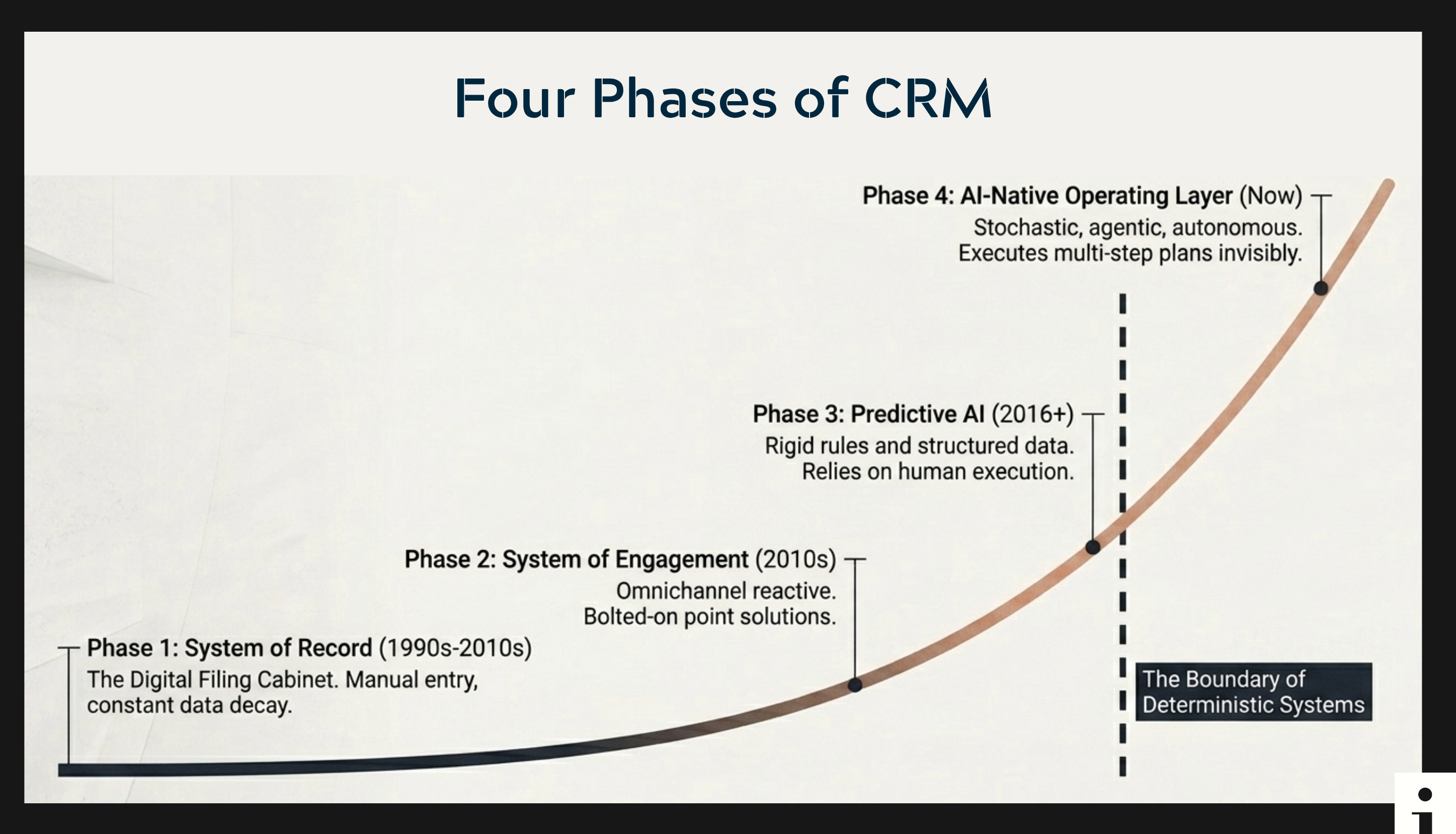
The first, spanning roughly the 1990s through the 2010s, was the system of record. CRMs in this era were digital filing cabinets. They replaced the Rolodex and the wall of sticky notes with structured databases for contacts, accounts, and pipeline stages. The primary interaction was manual data entry, which meant the system was only as good as the human feeding it. Advisors experienced CRM as an administrative tax imposed by management for the purpose of monitoring activity, not a tool that made their own work easier. Data decayed constantly. Adoption was grudging at best.
By the 2010s, customer expectations had shifted toward omnichannel digital experiences, and CRM followed them into a second phase: the system of engagement. Platforms absorbed marketing automation, service ticketing, and digital onboarding. They managed communications across email, phone, and chat. But the underlying logic was still reactive: the system waited for a client to raise their hand, submit a complaint, or download a whitepaper before triggering a rules-based workflow. The architecture was a collection of point solutions bolted onto a core database, and the result was a fragmented client journey where the service desk had no visibility into what the advisor discussed last Tuesday.
Predictive AI brought a third phase around 2016, when platforms like Salesforce launched early machine-learning features. CRMs started offering lead scoring, churn predictions, client segmentation, and basic next-best-action recommendations. This added predictive capability, but it was constrained by deterministic technology. The AI operated on rigid, predefined rules and structured data sets. It could flag a statistical pattern, such as a portfolio drifting from its target allocation, but everything downstream of the flag still fell on the human: researching the context, drafting the communication, staging the trade. The system generated insights. It could not act on them.
The fourth phase, the AI-native operating layer, is emerging now with the maturation of generative AI and agentic architectures. The difference is that an AI-native CRM operates as a stochastic system rather than a deterministic one. It can perceive dynamic, unstructured environments. It can reason through ambiguity. It can plan multi-step actions and carry them out without constant human direction. Microsoft is embedding Copilot agents into its business applications. Salesforce positions Agentforce as a “proactive, autonomous AI application” whose agents reason and take action. ServiceNow says its Customer Service Management “goes beyond CRM,” removing silos, connecting service with other teams, and orchestrating workflows in what it calls a “system of action.” These are architectural declarations.
The practical consequence is that the CRM stops being a destination application, a monolithic dashboard that a user must log into and navigate. It becomes a headless orchestration layer that surfaces intelligence directly into email, Slack, Teams, or whatever tool the user already has open. The advisor never visits a CRM screen. The CRM comes to them, invisibly, through the tools they already use.
What the new CRM actually competes on
If the old CRM competed on fields, forms, and configurability, the new one will compete on three things: signal quality, workflow execution, and governed data architecture.
The signal quality question is the most commercially interesting. The useful definition of an “opportunity” in an AI-native CRM is broad: any moment where better timing, context, or action can create value. In wealth management, that includes revenue opportunities, attrition prevention, service acceleration, compliance remediation, and trust-building outreach. The CRM continuously monitors five families of triggers.
Relationship and life-event triggers detect mentions of family changes, career shifts, or geographic moves in meeting transcripts, emails, or notes.
Portfolio and planning triggers fire when portfolios drift from risk corridors, when tax-loss harvesting windows open, when required minimum distributions approach, or when idle cash drags on returns during inflationary periods.
Behavioral and digital triggers track portal logins, content consumption patterns, missed meetings, and sentiment shifts, surfacing demand or dissatisfaction before they show up in attrition data.
Service and compliance triggers catch unresolved cases, communication gaps, and missing records.
External and market triggers connect rate changes, tax policy shifts, and relevant public information to the specific clients they affect.
Each of these trigger families already exists in some form across wealth-tech platforms. Envestnet supports tax overlay and tax-loss harvesting analytics. Nitrogen offers risk alignment, portfolio analytics, and tax insights. Bento Engine tracks regulatory birthdates and milestone-based triggers. Salesforce Financial Services Cloud positions relationship intelligence and meeting data as inputs to action. The individual building blocks are available. What makes the AI-native CRM different is the orchestration: the trigger fires, the system resolves it to the right client and household, infers whether it represents a need or a risk, prioritizes it against competing actions, acts through either a human prompt or an automated workflow, and then logs the outcome to improve the model over time.
The second competitive axis is workflow execution across systems. An advice moment in wealth management rarely stays inside a single application. It spans CRM, planning software, portfolio management, communications, service platforms, and specialist teams. The CRM that can orchestrate a workflow across all of these systems, routing the right task to the right person or agent at the right time, has a durable advantage over one that generates a notification and hopes the human figures out the rest.
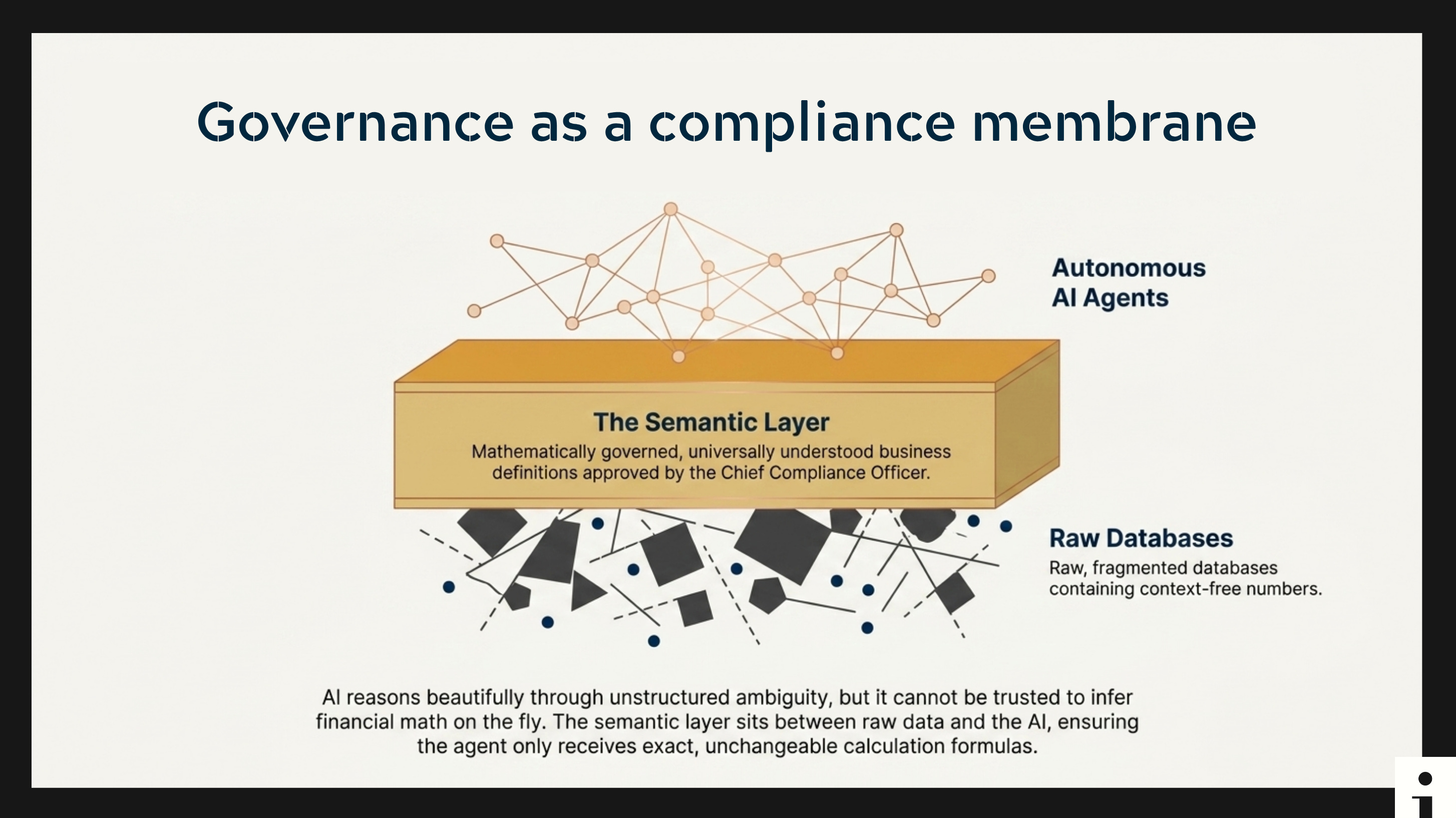
The third axis is the one that separates firms that will scale AI safely from firms that will build expensive compliance problems: governed data architecture. The industry calls this the semantic layer. The idea is simple enough to state in a sentence, but the execution is demanding. Legacy data models, designed for human analysts who carry enough context to fill in logical gaps, do not work when an autonomous AI agent queries them directly. If an AI agent is asked to identify clients with declining assets under management, it will attempt to infer the calculation on the fly, and it will do so confidently, plausibly, and incorrectly. In a regulated industries, that is a straightforward compliance violation.
A semantic layer sits between the raw data and every AI agent in the firm. It maps context-free numbers from dozens of databases to mathematically governed, universally understood business definitions. When an agent needs to evaluate a client metric, it queries the semantic layer and receives the exact, unchangeable formula that the chief compliance officer uses. The AI reasons through ambiguity and unstructured data, which is what it is good at. The semantic layer handles the math, which is what it is not. Neither works without the other.
This architectural distinction will determine which features become table stakes and which remain durable differentiators over the next five years. Meeting summaries, email drafting, conversational search, and basic copilots are heading toward commodity status, with nearly every major platform building them simultaneously. The harder-to-copy assets are household-level entity resolution, historical interaction memory, outcome-labeled trigger models, compliance-aware actioning, and the closed-loop learning that improves recommendations based on what actually worked.
Why this matters most where you would expect it least
Wealth management is an instructive case study for AI-native CRM because the structural pressures are severe and the workflow fragmentation is pronounced. The gap between what AI can deliver and what current systems provide is wide.
Start with the demographic math. A large share of the current advisor base is expected to retire over the next decade, and Cerulli-related reporting estimates that retiring advisors control roughly 42% of advisor-managed assets. The pipeline meant to replace them has historically been thin, with high attrition rates among new entrants. Multiple industry analyses, including McKinsey’s, project a substantial advisor shortfall by the mid-2030s. Hiring alone will not close the gap. The only remaining lever is to change how much a single advisor can accomplish, and the research points toward a need for meaningful, double-digit productivity improvement just to close the emerging capacity gap.
The demand side is moving in the opposite direction. The largest intergenerational wealth transfer in history is underway, and the heirs receiving trillions of dollars in assets grew up in algorithmic consumer ecosystems. They expect proactive, personalized, always-on service. Capgemini’s 2026 World Wealth Report emphasizes that proactive, personalized communication from relationship managers is now a top client priority. These clients will not tolerate annual reviews and generic newsletters.
At the same time, the scope of advice is expanding. As allocations to private, illiquid, and alternative assets increase, and as clients expect holistic life planning rather than basic asset allocation, the cognitive load on each advisor has multiplied. Modern clients are aware of fee compression and will not pay a 1% annual fee for a standard diversified portfolio. They expect bespoke tax optimization, multi-generational estate structuring, philanthropic planning, and behavioral guidance.
Historically, the cost of delivering that level of service was prohibitive for all but the wealthiest clients. The unit economics did not support family-office-level attention for mass-affluent accounts. AI-native CRM changes that equation by industrializing the production of technical outputs. Generative AI can produce complex scenario models, tax-loss harvesting analyses, and personalized portfolio rationales that previously required hours of analyst labor. The marginal cost of producing first-draft planning outputs drops. The cost of interpreting those outputs, coaching the client through their implications, and taking fiduciary responsibility for the recommendation does not.
BCG’s field research on the “jagged technological frontier” is the framework that makes sense of all this. AI substantially improves performance on tasks within its competence boundary, but actually degrades outcomes when humans rely on it for tasks outside that boundary. The wealth management application is a reasonable extension of that research: the frontier here is deeply irregular. An AI can generate a first-pass technical draft or scenario model in seconds. It cannot sit in a room with three siblings who do not trust each other and navigate the emotional politics required to get a plan signed. The technical output is inside the frontier. The human judgment is outside it.
The advisor’s economic value is therefore migrating from production to interpretation and accountability. The advisor who charged for building financial plans has a problem. The advisor who charged for interpreting those plans, coaching clients through volatility, and answering the phone at 10 PM during a market crash becomes more valuable.
Morgan Stanley’s deployment provides early evidence. Its internal AI architecture saw wide adoption across advisor teams and reportedly improved how quickly advisors could locate internal research and documents. Its Debrief tool, which captures meeting notes and action items automatically, saves advisors roughly 30 minutes of administrative wrap-up per meeting. Those hours go to prospecting, deepening relationships with top-tier clients, and, in many cases, going home at a reasonable hour. RBC Wealth Management reported similar results: unified data and Salesforce’s Agentforce reduced manual processes and meeting prep, freeing advisors to spend more time with clients.
There is also a quieter institutional benefit. Veteran advisors heading for the exits carry decades of relationship-building intuition: the instinct for when to push and when to listen, the phrasing that makes a skeptical client actually hear difficult advice. That knowledge has never been captured in any CRM field. AI-native platforms could eventually ingest the historical patterns of veteran advisors, drawing on successful conversational approaches, email cadences, and meeting notes, and surface that wisdom as real-time coaching for junior staff. If it works at scale, it would amount to automated apprenticeship, and it is a capability few firms are discussing yet.
None of this is frictionless. The risks are real, and executives who treat AI-native CRM as a straightforward technology purchase will get burned.
Regulators are not writing new AI-specific rulebooks. They are applying existing securities laws to algorithmic behavior with increasing creativity and aggression. The SEC fined two advisory firms a combined $400,000 for “AI washing,” making false claims about their use of AI in investment processes. If a firm claims its systems use advanced AI, those claims must be technically defensible and actively supervised.
The compliance implications extend beyond marketing. Under SEC recordkeeping rules (Rule 204-2, Exchange Act Rules 17a-3 and 17a-4) and FINRA Rule 4511, the scope of what constitutes a regulated record is expanding. If an AI agent drafts a client email, the output must be archived. The prompt that produced the output, the specific instructions and data context that shaped the recommendation, may also qualify as a regulated record depending on how it is used. The firm must be able to explain, to a federal auditor, why a specific AI agent suggested a specific strategy for a specific client on a specific Tuesday.
Data quality failure is dangerous in its own right. If household relationships, beneficiaries, and service histories are fragmented or incorrect, the opportunity engine will generate false relevance at speed. Salesforce, Microsoft, ServiceNow, and Advisor360 all now market unified data as a precondition for AI value, which is effectively an industry-wide admission that weak data architecture is the principal bottleneck.
And there is the risk of over-automation itself. Wealth is emotional, tied to legacy, security, and family identity. If clients perceive that they are communicating with an algorithm rather than their trusted fiduciary, they will demand fee compression commensurate with low-cost robo-advisory platforms. The AI must operate invisibly. It should augment the advisor’s empathy and scale their intelligence without replacing their voice.
Gartner predicts that over 40% of agentic AI enterprise projects will be canceled by 2027, citing escalating costs, unclear business value, and inadequate risk controls as the primary drivers. The practical lesson is to start with narrow, workflow-complete use cases where data is clean and risk is manageable, rather than attempting to transform the entire advisor desktop on day one.
The firms that execute this well will follow a sequenced approach rather than a big-bang transformation.
In the first twelve months, the priority is data and governance: cleaning the household graph, instrumenting communication capture, implementing prompt archiving for regulatory compliance, and deploying a focused set of lower-risk use cases such as meeting preparation, follow-up automation, and internal knowledge search. These are high-value starting points with manageable compliance exposure.
The next year shifts the focus from isolated assistants to cross-system trigger orchestration: integrating CRM with planning, portfolio, service, and specialist-routing workflows, defining a firm-wide opportunity taxonomy, and redesigning advisor team structures around the new capabilities.
By month thirty-six, leading firms should decide which layer they want to own. The strategic directive is concise: buy the plumbing, own the intelligence. Let vendors provide data infrastructure, security, and workflow tooling where they are already scaling fast. Build proprietary relationship logic, trigger policies, and outcome-learning loops where the firm’s specific client mix, advisor behavior, and regulatory posture create advantage.
The vendor landscape is converging from three directions. Horizontal CRM platforms like Salesforce, Microsoft, and HubSpot are adding agentic AI, unified data, and workflow orchestration. Workflow-native challengers like ServiceNow and Pega argue that the next era of CRM is really about orchestrating cross-functional work and decisioning. And wealth operating platforms like Advisor360, Orion, Envestnet, and Practifi are trying to own the advisor desktop and the wealth-specific data model. These three groups are headed for the same territory, which is why the category boundary is blurring.
The likely end-state is both an advisor operating system and a firm intelligence layer. For users, the system will feel like one conversational workspace that prepares meetings, surfaces opportunities, drafts outreach, and routes service requests. For the enterprise, the more defensible layer is the intelligence fabric underneath: the evented data model, the decisioning engine, the workflow layer, and the governance framework. If forced to choose which matters more strategically, the answer is the second. The durable moat sits in the intelligence layer. The advisor operating system is how that layer shows up in daily work.
The CRM label will probably survive. But the software category it describes is in the process of swallowing, or being swallowed by, the entire enterprise workflow stack. If you haven’t started cleaning your data, that is the first problem to solve.