


This is a long read. Pour yourself a coffee.
If you work in wealth management and have ever typed a question into ChatGPT, you need to read this. If you work in wealth management and haven’t — you especially need to read this.
Part I — The Tools on Your Desktop
You’re Already Using AI. Let’s Talk About What It’s Actually Doing.
Let me start with something uncomfortable: you’ve been using AI for months, maybe years, and you almost certainly don’t understand what it’s doing.
That’s not a criticism. Nobody sat you down and explained it. Your compliance department sent a PDF about “acceptable use.” Your CIO mentioned “guardrails” in a town hall. And you went back to your desk and kept typing questions into ChatGPT because it’s genuinely useful and nobody told you to stop.
This article is about understanding a technology that is rapidly reshaping the competitive landscape, so you can make informed decisions about when and how to use it — rather than having those decisions made for you by vendors, competitors, or inertia.
So let’s start there. Right at your desk.
When you open ChatGPT, or Google’s Gemini, or Anthropic’s Claude, or Microsoft Copilot—you’re interacting with a Large Language Model, or LLM. I need you to understand what that actually means, because the name is misleading. It’s not “large” in the way a database is large. It’s not a “language” model the way a dictionary is a language tool. And it doesn’t “model” language the way a grammar textbook does.
Here’s what an LLM actually is, at its foundation: a massive mathematical function trained to predict the next word.
But the techniques layered on top of that foundation — reinforcement learning from human feedback, chain-of-thought optimization, reward modelling, etc. — produce behavior that goes far beyond simple prediction.
When you type “What are the tax implications of a Roth conversion for a client with—” the model has processed trillions of words during training — books, websites, academic papers, forum posts, financial filings — and it has learned statistical patterns about which words tend to follow which other words in which contexts.
But here’s why that undersells it: the patterns are so deep, so layered, so multivariate, that the behavior that emerges looks remarkably capable. It can draft a client letter. It can explain a complex estate planning structure. It can summarize a 50-page investment memo.
Whether the model truly “understands” any of this in the way you or I do is a philosophical question that remains genuinely unresolved. But for your purposes:
The question that matters isn’t whether it understands — it’s whether the output is reliable enough for your specific use case.
The answer depends on the task, the model, and the verification process you have in place. We’ll come back to this throughout the article.
A few terms you need to know:
Prompt
A prompt is what you type. It’s your instruction to the model. But it’s more than that—it’s the only thing the model sees. Everything the model does is a response to the exact text in front of it. The quality of what you get out is directly proportional to the quality of what you put in. This is not a search engine where you throw in keywords. This is a conversation with a very fast, very capable, completely literal machine.
Token
A token is the unit the model thinks in. Roughly, one token equals about three-quarters of a word. When people say a model has a “200,000 token context window,” they mean it can hold roughly 150,000 words in its working memory at once—about 500 pages. We’ll come back to why that number matters enormously.
Model
A model is a frozen snapshot. When someone trained GPT-5.2 or Claude Sonnet, they exposed the model to vast amounts of text and ran mathematical optimization processes that took months and cost hundreds of millions of dollars. The result is a set of parameters—think of them as billions of tiny dials, each tuned to a precise position. Once training is done, those dials are locked. The model doesn’t learn from your conversations. It doesn’t get smarter over time from your usage. It’s a photograph of a learning process, not the learning process itself.
This distinction matters more than anything else in this article, and we’ll keep coming back to it.
The Modes You See But Don’t Understand
If you’ve used ChatGPT or Claude recently, you’ve probably noticed you can choose between different modes. They have different names on different platforms, but they map to the same underlying concepts. Let me walk you through them, because the difference between these modes is the difference between asking your intern a quick question and asking your best analyst to spend the day on a problem.
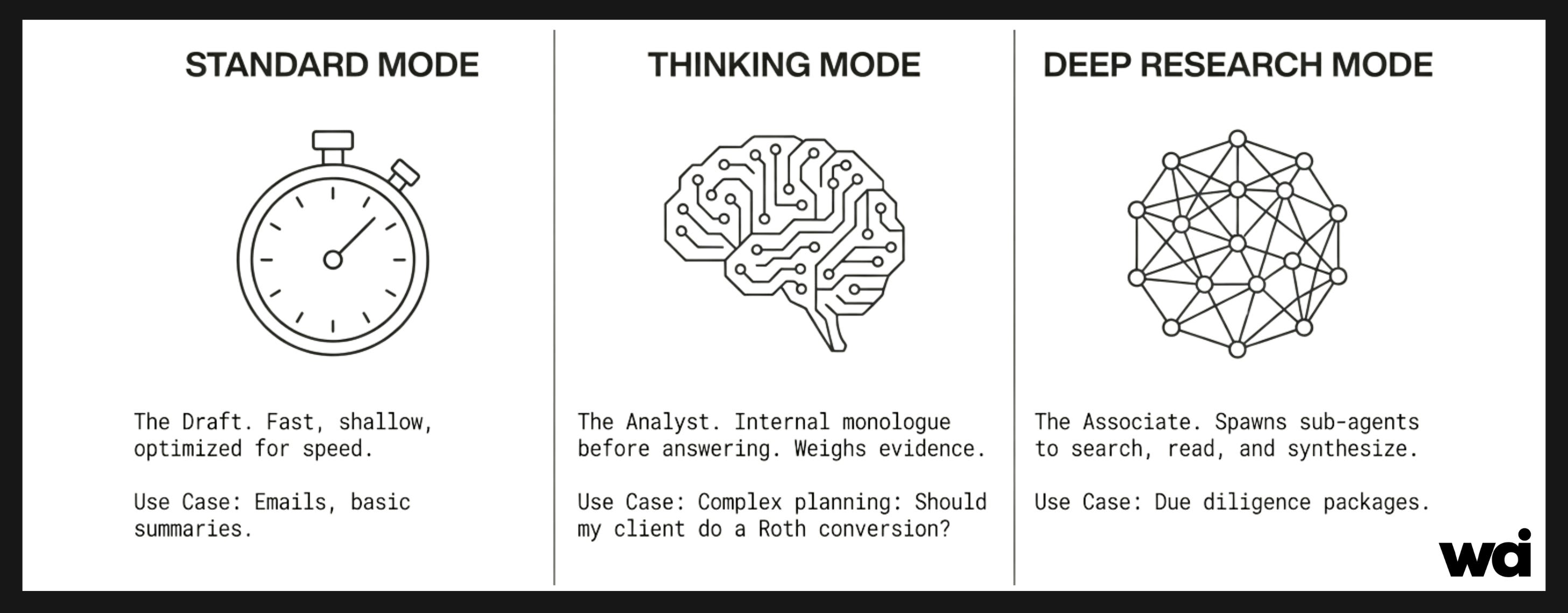
Standard mode (sometimes called “Fast” or the default)
This is what you get when you just type and hit enter. The model reads your prompt, generates a response token by token, and gives you an answer as quickly as it can. It’s optimized for speed and cost. The reasoning is shallow—not because the model is dumb, but because you’re essentially asking it to answer off the top of its head.
Think of it like your quick Bloomberg terminal lookup. You’re not asking for analysis. You’re asking for a fact, a draft, a starting point.
Thinking mode (called “Extended Thinking” on Claude, “Reasoning” on ChatGPT)
Here’s where it gets interesting. In thinking mode, the model doesn’t just predict the next word in its response. Before it writes anything you see, it writes to itself—sometimes thousands of words of internal reasoning. It breaks down the problem, considers edge cases, checks its own logic, and then synthesizes a response.
This is your analyst writing a memo. They’re not just pulling data—they’re structuring an argument, weighing evidence, and coming to a conclusion. The output is slower and more expensive, but materially better for complex questions. If you’re asking “Should my client do a Roth conversion this year given their specific situation,” you want thinking mode. If you’re asking “What’s the current federal estate tax exemption,” you don’t.
Deep Research mode
This is the most powerful mode available today, and most wealth management professionals have never used it. In Deep Research mode, the model doesn’t just think—it acts. It searches the web, reads multiple sources, evaluates their credibility, follows leads, revises its approach based on what it finds, and synthesizes everything into a cited report.
This is your associate spending a full day pulling together a due diligence package. They’re not answering from memory. They’re going out into the world, finding information, evaluating it, and building something comprehensive.
When Claude’s Research mode runs, it might spawn a team of sub-agents—one searching for regulatory filings, another pulling academic research, a third scanning news articles—all working in parallel, then feeding their findings back to a lead agent that synthesizes everything. The whole process might involve dozens of searches and hundreds of pages of reading, compressed into a few minutes.
The models that power these modes are not all the same. As of early 2026, the frontier of AI capability is being pushed by a handful of models that most people in wealth management have never heard of, let alone used. According to Artificial Analysis, which independently benchmarks every major model, the current leaders include:
Gemini 3.1 Pro Preview (Google)
GPT-5.3 Codex (OpenAI) — at the highest reasoning setting
Claude Opus 4.6 (Anthropic) — at the maximum capability tier
GLM-5 (Zhipu AI / China)
Kimi K2.5 (Moonshot AI)
Most of these are names you’ve never encountered. That’s the point. And we’ll get to why in Volume 2.
