


On April 17, 2026, a document landed on the desks of risk officers across the American banking system — particularly at the Fed-supervised institutions with more than $30 billion in assets where the guidance would bite hardest.
It was not long. It was not flashy. It carried the bureaucratic signature of the Federal Reserve, the OCC, and the FDIC — three agencies that rarely agree on lunch, let alone policy. The document was called SR 26-2, and buried in its scope note was the sentence that matters for AI agents: generative and agentic AI models are not within the scope of this model-risk guidance.
For years, banks had governed their machine learning systems under a framework called SR 11-7 — a set of rules designed for the kind of statistical models that decide your credit score or flag a suspicious wire transfer. These models are repeatable in production scoring — feed them the same inputs, and they produce the same outputs. You can audit them. You can explain them. You can prove, to a regulator’s satisfaction, that they behaved as intended.
SR 26-2 acknowledged that the new generation of AI — the agents that plan, reason, call APIs, browse the web, write code, and make decisions across multi-step workflows — are fundamentally different beasts. The old model-risk playbook is not enough for systems that interact with live infrastructure. Banks would need broader, tailored risk management and IT governance frameworks to contain them.
These systems are probabilistic in a way traditional scoring models are not. And in the world of regulated industries, that distinction — probabilistic reasoning without deterministic boundaries — is the difference between a system you can defend in front of a regulator and one you cannot.
This is a story about that gap. About what happens when the most capable technology humanity has ever built collides with the systems that hold civilization together: banking, healthcare, insurance, law, critical infrastructure, cybersecurity. About why the companies that will win the next decade of AI are not the ones building the most autonomous agents, but the ones building the most constrained ones.
And about why constraint, far from being the enemy of intelligence, might be the only thing that makes intelligence trustworthy.
The Improviser and the Air Traffic Controller
Here is a thought experiment.
Imagine two professionals. The first is a jazz musician — brilliant, intuitive, capable of improvising breathtaking solos in real time. She listens, adapts, responds to the room. No two performances are the same. Her genius is in her unpredictability.
The second is an air traffic controller. She is also brilliant. She also listens, adapts, and responds in real time. But her job demands the opposite of improvisation. Every instruction she gives follows a rigid protocol. Every aircraft she routes obeys a deterministic sequence. Her genius is in her predictability. Because when a 747 carrying four hundred people is descending through fog at 160 knots, the last thing anyone wants is creative interpretation.
Modern agentic AI is the jazz musician.
Regulated workflows need the air traffic controller.
The tragedy — and the opportunity — of 2026 is that nearly every enterprise deploying AI agents is asking the jazz musician to land the plane. They are deploying systems whose core reasoning engine is, by the explicit admission of every major AI provider, inherently non-deterministic, into processes where non-determinism is not merely inconvenient but potentially illegal.
OpenAI’s own prompting guidance states it plainly: large language models are inherently non-deterministic. Anthropic’s research has shown, in controlled experiments, that advanced reasoning models often do not faithfully reveal the factors that influenced their answers — what developers see is frequently a summary, or a partial representation, of internal reasoning. This is not a bug that will be patched in the next release. It is an architectural property of autoregressive token generation — the mathematical foundation upon which every frontier model is built.
And yet.
And yet these systems can do extraordinary things. They can read a two-hundred-page insurance claim, extract the relevant facts, cross-reference them against policy language, and draft a preliminary assessment in minutes rather than days. They can monitor regulatory filings across jurisdictions, flag material changes, and route alerts to the right compliance officer. They can assist a clinician in synthesizing a patient’s fragmented medical history into a coherent narrative. They can triage cybersecurity incidents, correlate threat intelligence, and propose containment strategies.
The value is real. The capability is genuine. The question is not whether agentic AI belongs in regulated workflows.
The question is how.
What Determinism Actually Means (And Why Everyone Gets It Wrong)
Let’s kill a misconception before it metastasizes.
When most people hear “determinism” in the context of AI, they imagine a system that produces the identical output every time it receives the same input — token for token, character for character. If the model says “approved” today, it must say “approved” tomorrow, in the same font, with the same punctuation.
That definition is useless. It describes a lookup table, not an intelligent system. And it misses the point entirely.
Operational determinism — the kind that actually matters for regulated workflows — is something far more interesting. A system is operationally deterministic when the workflow around the model has deterministic boundaries: deterministic permissions, deterministic state transitions, deterministic evidence rules, deterministic approval points, deterministic logging, deterministic escalation paths, and deterministic rollback mechanisms.
The model inside can still be probabilistic. It can still improvise. It can still exercise the fluid, contextual reasoning that makes it valuable. But it improvises inside a cage. The cage — the workflow, the policy engine, the approval gates, the audit ledger — is what makes the system compliant.
This is not a new idea. It is one of the oldest ideas in civilization, repackaged for the age of artificial intelligence.
The ancient Romans understood it. They called it imperium — the bounded authority granted to a magistrate. A consul could wage war, levy taxes, and pronounce judgment. But only within his province. Only for his term. Only subject to the veto of his colleague. The power was immense. The constraints were absolute. And it was precisely the constraints that made the power legitimate.
Two thousand years later, the principle is identical. The AI agent is the consul. The deterministic workflow is the constitution. Without the constitution, the consul is a tyrant. Without the consul, the constitution is inert. You need both.
Call it the Bounded Consul Principle: the power of a system is inseparable from the legitimacy of its constraints. An unconstrained agent is not a more powerful agent. It is an ungovernable one. And in regulated industries, ungovernable is a synonym for unemployed.
The Compliance Vocabulary You Need
Before we dissect how each piece of agentic AI creates specific risks in regulated environments, we need a shared language — the kind that practitioners use when they’re troubleshooting at 2 AM and the regulator’s letter has a thirty-day deadline.
A compliance-forward workflow is a process designed first for lawful operation, recordability, privacy, supervisory review, and incident handling — and then for automation efficiency. It aligns with NIST’s GOVERN/MAP/MEASURE/MANAGE framework and ISO 42001’s management system thinking. The key insight: compliance is not a feature you bolt on at the end. It is the architectural foundation you pour before you build anything else.
Auditability is the ability to reconstruct what happened, by whom, on what basis, with what tools, versions, and permissions. The EU AI Act’s logging and technical documentation obligations are direct examples. When a regulator asks “why did your system do this?”, auditability is the difference between a satisfying answer and a subpoena.
Traceability is auditability’s sibling — the end-to-end linkage between inputs, retrieved evidence, model versions, tool calls, actions, and outputs. If auditability tells you what happened, traceability tells you how the dominoes fell.
Explainability is the ability to render the logic behind an action understandable to a human auditor, clinician, or regulator. Not “interpretable neural network weights” — that is an academic exercise. Explainability means a compliance officer can read the decision trail and say, “Yes, I understand why the system reached this conclusion, and I can defend it.”
Reproducibility is the ability to replay, simulate, or reconstruct the decision pathway using preserved state, event history, and version references. This is the gold standard. If you cannot replay the decision, you cannot audit it. If you cannot audit it, you cannot defend it. If you cannot defend it, you have a problem.
And then the two modes of human oversight that every board member should understand:
Human-in-the-loop means a human must approve or supply input before designated actions continue. The workflow halts and waits. No approval, no action. This is the safety net for high-stakes, irreversible decisions.
Human-on-the-loop means a human supervises, monitors, and may intervene — but does not necessarily approve each decision before execution. The agent operates autonomously within bounds, and the human watches the dashboard. This is the operating mode for lower-risk, reversible processes where speed matters more than individual case review.
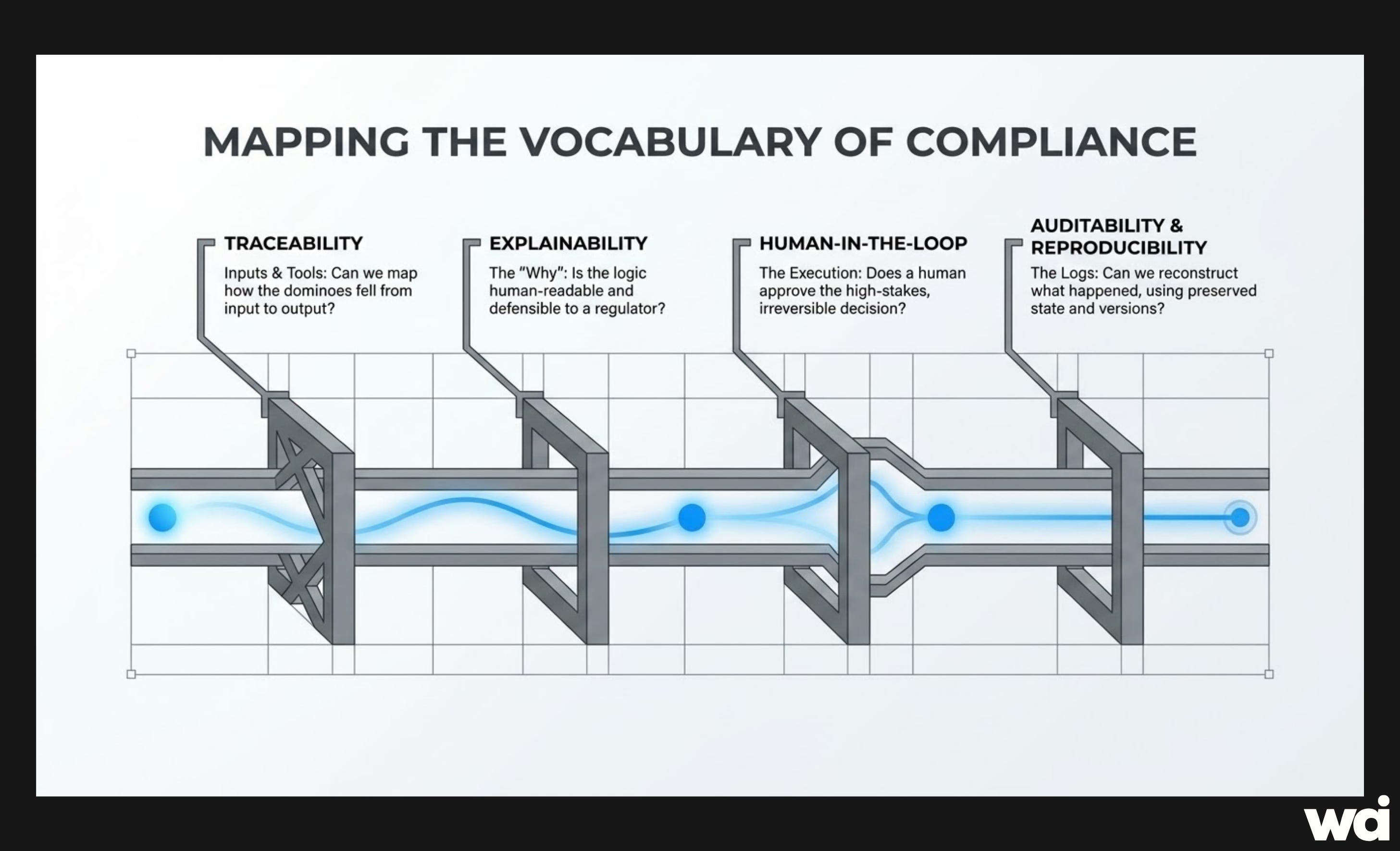
The difference is not academic. It is the difference between a surgical team and a night-shift security guard. Both are watching. Only one has their hands on the scalpel.
You now understand why unconstrained AI agents are structurally incompatible with regulated workflows. What you don’t yet have is the blueprint — the specific failure mode inside each agentic capability (tool calling, RAG, memory, multi-agent orchestration, GUI agents), the design pattern that neutralizes it, the 9-layer architecture stack that makes compliance native, and the maturity model that tells you exactly where your organization stands today. That’s what the rest of this piece delivers.
